Guest Post: “The Instructor-Student Gap: Why Your Students Still Suck” by Josh Stewart

Any good instructor’s process is always under scrutiny. The instructor looks at the students and wonders, “Why aren’t they doing what I asked?” or “Is that really what I showed them?”

giphy

Self-doubt is a valuable tool in martial arts both as a student and as an instructor. As a student, when the instructor makes a correction or provides feedback, there should always be the assumption that you are the one doing it wrong. If that’s the baseline assumption, then if it’s not true, you have reminded yourself of something you are doing correctly, and if true, then you have found an area to fix.

As an instructor, this can be somewhat more difficult. The reality is that there will always be a gap between what you teach and what somebody else learns. It could be physiological differences, miscommunication, or varying learning styles that cause this discrepancy to exist.

Physiological Differences:

Age and injury account for a number of physical limitations that may prevent students from doing exactly what the instructor does, but there are also a number of other biological factors that affect how an individual performs a particular technique.

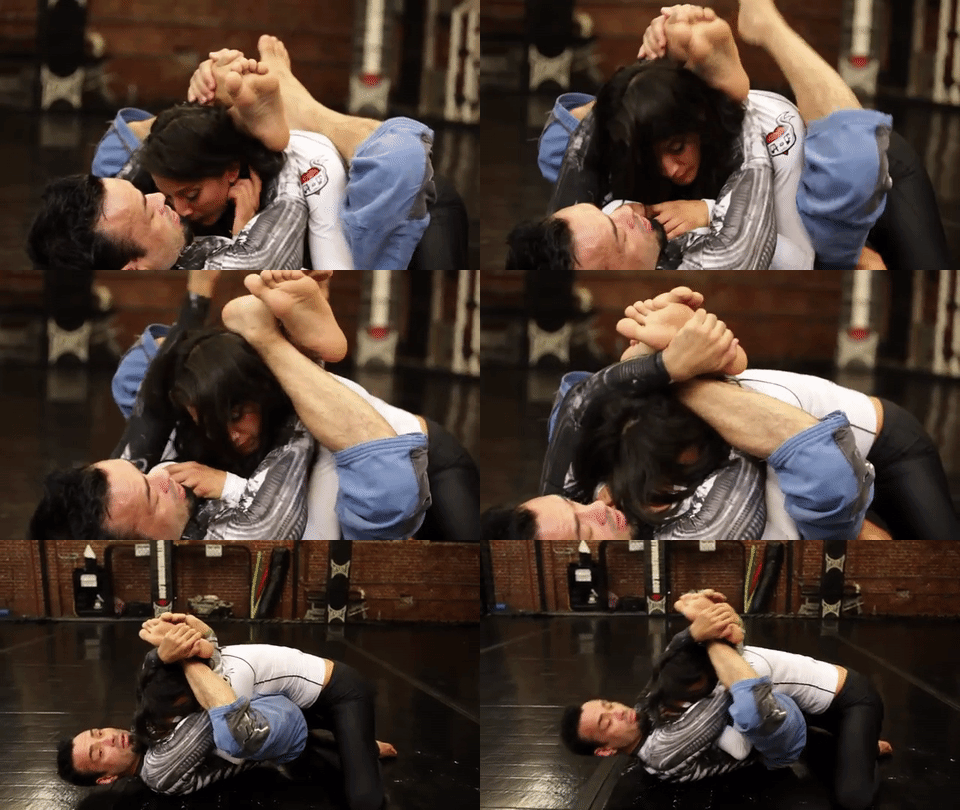
Flexibility, or lack thereof, has a vast effect on how the body moves. Stances and kicks are obvious areas where flexibility provides a greater range and may limit a student from copying exactly how an instructor executes a movement. Grappling is another area where strategy or technique selection can be largely determined by flexibility. For example, Eddie Bravo’s 10th Planet system is designed with the assumption of a certain range of motion, and someone without that capacity may struggle to emulate those exact sequences.

giphy1

However, I have also noticed that double-jointed students often have difficulty limiting their flexibility by contracting muscular groups effectively at the right times. Even a simple straight punch, executed by someone with a lot of flexibility, sometimes gives the appearance and feeling of being floppy when joints hyperextend without suitable muscular contraction to support the energy transfer.

Stature is another contributing factor. Bigger, more muscular people may rely on their size and strength advantage when working with a smaller partner, leading to neglect of correct footwork, positioning, or body mechanics because they can “get away with” doing the technique incorrectly—until they encounter a training partner their own size. Conversely, smaller students may have to supplement their techniques with extra kicks, knees, or groin slaps to help bring larger partners down to their own level. Otherwise, they may struggle to achieve the intended outcome because they simply can’t reach the targets designed in the training exercise.

Miscommunication:

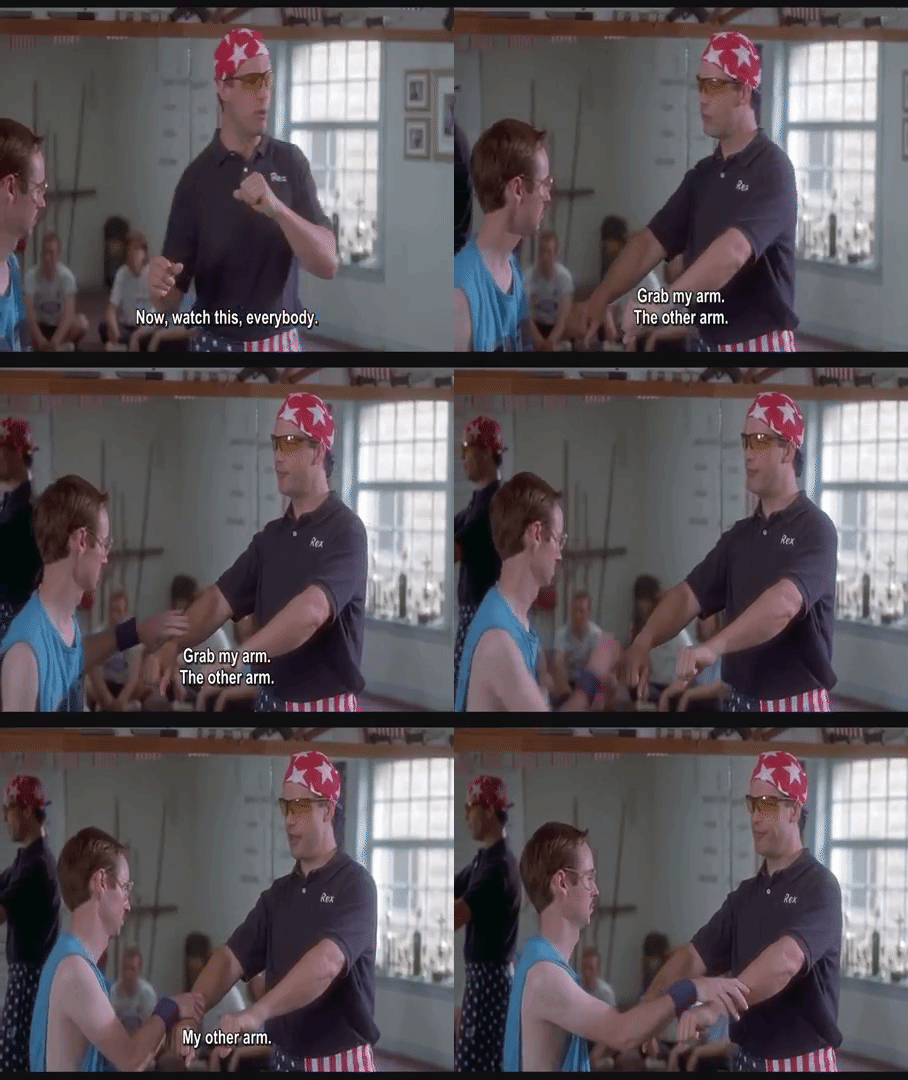
As the word suggests, this occurs when one or both parties involved are not on the same page in regards to what is being asked. Any martial arts instructor who teaches kids knows that lack of listening or focus has a vast impact on this process, but it is certainly not limited to children.

Adults, especially advanced ones, tend to experience miscommunication because they believe that they already know the message being delivered. Again, the correct default for a student should be to assume they know nothing and are doing it all wrong, but naturally after several years of training, the ego may want us to assume otherwise.

fullsizeoutput_887

Of course, it takes two to tango. Instructors sometimes give vague or contradictory pieces of information about how a technique or strategy should be applied. Another source of miscommunication that can be blamed solely on the instructor is talking over the students’ heads. At times there may be too much technical jargon that learners will not be familiar with, in which case the verbal instruction may not transfer any useful information to the group. Instructors always need to remember who their audience is to ensure that the right level of detail is being provided at the right time in the learning process.

To limit miscommunication, creating an environment where it is safe to ask questions is vital. If a student asks for clarification and gets an abrupt, rude response, that will be the end of the process. Unfortunately an instructor’s ego is also involved in this process, often leading to the conclusion: “Well, I explained it clearly . . . What’s wrong with these students for not getting it right?” Just like the student, the instructor’s baseline assumption should be the opposite. If the students aren’t getting it, the onus should first be on the instructor to try again to deliver the lesson clearly and effectively.

Learning Styles:

Of course, there has been a lot of research into kinesthetic, auditory, and visual learning. The established reality is that, while we may rely more heavily on one rather than the other, each is a spectrum, and depending on what we are learning, we use each to varying degrees. In martial arts, we virtually always rely on them all: we listen and watch as the instructor presents the material, then we practice it physically.

Learning style also affects how an instructor delivers lessons in terms of how much context to give. Some learners are “big picture” oriented—they won’t understand the piece of a puzzle unless they know what the entire scope of the puzzle is. However, others are happy just to take one piece and practice it, and worry about the next step in the process when they get there. While one learner might be confused by being asked to deliver a technique without knowing what came before and what will come after it, another will be bored by the teacher’s long, unnecessary rant about the history and functionality of a certain sequence that they haven’t had the chance to practice yet.

fullsizeoutput_5c9

Body language is a key to understanding a student’s learning style. An auditory learner stands closely to the instructor and leans in to hang on every word; a visual learner re-positions to get the best angle to see what’s happening; a kinesthetic learner mimics the instructor as the movement is being demonstrated. Global learners may walk back to their partner shaking their heads or linger longer than others, hoping for more explanation. Analytic learners may look restless when the big picture is explained and will be the first one back to their partners.

In any group of students, there will typically be a standard distribution of students who will learn faster than average with less practice, those who will achieve proportionally to the amount of effort they expend, and those who are ultimately destined for failure despite their best efforts. The instructor’s role dictates catering to those in the second category. If students are struggling to perform the technique as being explained and demonstrated, the instructor should first look at the potential of his or her own failure before moving to the conclusion (although sometimes correct) that the student is the one responsible for missing the mark.

Author Bio Josh Stewart

Enjoyed this post? Follow The Martial Arts Muse on Facebook for more Martial Arts Musings!

The Martial Arts Muse Tatami Promo

Being A Good Uke; It’s Harder Than You Think

Have you ever watched your Sensei choose one individual over and over again to be his Uke and thought, “Why not me!?”

In any seminar or class, you’ll find the head Sensei will consistently pick the same individuals to work with when demonstrating techniques. I think many of us would love to “volunteer as tribute” and feel the glory of being at the front of the dojo with your head Instructor!

54jlduln5bowm

But, there are many reasons why some people are chosen more than others.

From time to time, an individual is chosen because of their size. A Sensei may choose the largest person in the room—usually to prove a point about technique vs. strength/size.

48xthdulxddeo

Sometimes an individual is chosen because of flexibility, so that the Sensei can execute the full extent of an armbar or leg lock without the individual tapping.

gbignlikts3gu

But usually, one is chosen as a demonstration Uke because they’re amongst the best in the room.

You would think that letting the teacher hurt you would be easy, that any dummy can do it!

But, not just any dummy, a very skilled dummy. . .

13vpdvincvvil2

To be a good Uke and especially an Uke for demonstrations, you literally have to know what you’re getting yourself into. By that I mean you have to be familiar with many, if not all, the possible positions the Sensei may put you in, sometimes without the Sensei even telling you what she/he will be applying. So, unless you have a crystal ball with you, you either have to have superb body awareness and biomechanical knowledge or completely memorized the curriculum.

The Sensei, like Goldilocks, is looking for someone that is not too hard or too soft.

They’re looking for an individual that will

  1. Comply and restrict at just the right moments and with just the right intensity
    • Nothing (and I do mean NOTHING!) is more annoying to a head Sensei than a Uke who anticipates a technique and gives an unrealistic reaction, like moving before the technique was actually applied, OR actively resists when the Sensei is demonstrating. The key here is to respond, not anticipate, the Uke must have a complete understanding of the intent of every technique that they are subject to and respond accordingly with enough resistance for the demonstration to run smoothly and realistically.
  2. Set a good technical example when they return a technique
    • The Uke must know how to receive, counter and execute techniques with the same speed, power and skill as the Sensei applying it. If the Uke does not adequately perform a technique, the lesson the Sensei is trying to teach could be lost and the entire group could end up doing the technique, counter or sequence completely wrong! (No pressure or anything!)
  3. Most importantly, make the head Sensei look good!
    • As an Uke, it is your responsibility for the demonstration to look as good as your body will physically allow because when you are asked to present with the Sensei (especially at a seminar), you have become a representative of that Sensei, an extension of their name/style.

AND

The Uke must do all of this while being submitted to various degrees of pain, being put in the most awkward of awkward positions and essentially getting the crap kicked out of them!

rxsfebozub3zc

So, the next time you ask “Why not me!?” remember we often overlook the skill of the Uke. Instead, concentrate on the small details the Uke demonstrates because getting the crap kicked out of you isn’t as easy as you think.

April’s Video of the Month: Master Ken

Carol Burnett said that “comedy is tragedy plus time.”

This is what I think of when I watch Enter the Dojo’s Master Ken.

Why do martial artists of every style watch and enjoy Enter The Dojo, when almost all our arts have been noted as “Bullshit?”

Well. . . Because it’s true!

For every legitimate martial artist out there with an understanding of body mechanics and the reality of violence, there’s dozens who have no idea what they are doing.

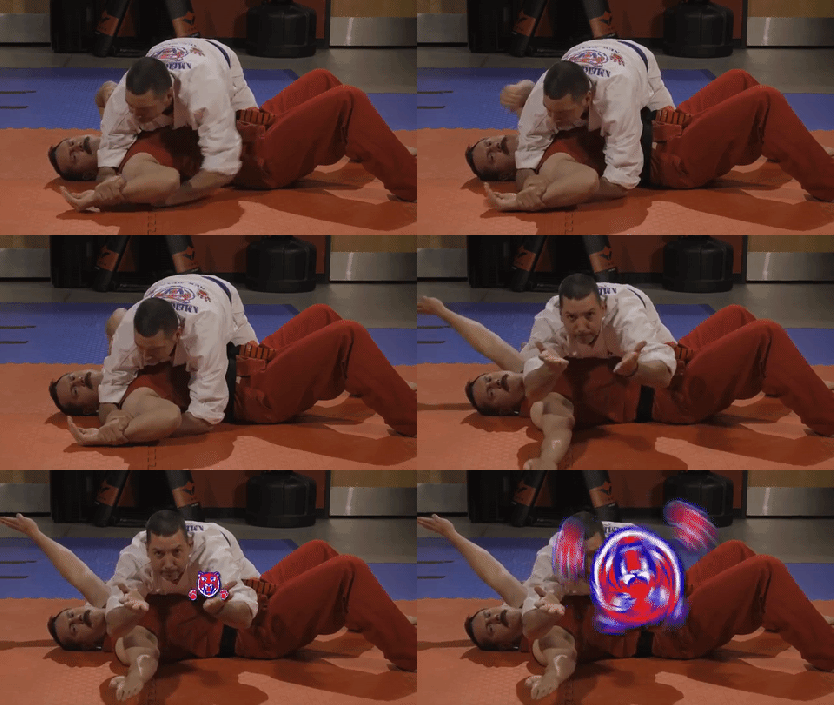
Master Ken’s satirical style, Amerido-te, embodies the shortcomings that all martial arts styles are subject to and, through its comedy, criticizes the unwavering dedication and naive devotion that many martial artists display.

This particular episode calls attention to the sport elements of BJJ, where in practice one always has the option of tapping – an unrealistic strategy for a street encounter.

The Web Master: Spinning Concepts with Sensei Paul Lopresti – Part 2

It’s better to have a tool and not need it than need a tool and not have it.

This point summarizes the necessity of adding grappling to our fighting repertoire. And as I mentioned in the first part of this series based on my learning experience with Sensei Paul Lopresti, grappling is a common aspect of self-defence overlooked by many karate practitioners. I find this especially frustrating because so many kata techniques are applicable on the ground, as illustrated in my previous discussion of kokutsu dachi and knee on belly position.

Sensei Paul Seminar-Group

Another standing technique found in karate and other striking arts is the hiza geri (knee). If someone is properly executing a hiza geri with all their body weight moving into the technique and the hips driving forward, one can very much see the mechanical similarity of the hips in shiko-walk.

The shiko-walk is a common grappling technique used in a double leg take down or the knee cutter guard pass to kesa-gatami, in which you press your knee onto the inside of the opponent’s thigh.

With that said, Sensei Paul spun further applications of hiza-geri through his presentation of a ground drill of his own creation, completely committed to the bottom position, called Ura Ne-Waza. Based on my understanding, the creation of the drill was a critique of common grappling practices. Most BJJ clubs teach grappling from a superior top position and rarely address ways of being successful while on one’s back.

The inspiration for ura ne-waza was one of Sensei Paul’s female students. She constantly found herself on her back against bigger opponents—the type of opponent a woman is most likely to find herself against. With ura ne-waza, students can protect themselves against larger opponents by using various restraining techniques and submissions, like the guillotine or kimura, from their back.

Jen And Anthony

One position in the drill is called “knee in guard,” which uses the exact same body mechanics of a standing knee strike or shiko-walk.

In this position you stick to the opponent’s body by:

  • Under-hooking the left arm with your right arm and grabbing the opponents right wrist with your left hand
  • Pressing your left knee into the crevice of the elbow and bracing the bottom of the left foot on the right side of the opponent’s hip.

Josh And Ray

In doing the “knee in guard” position, you prevent the opponent from attempting a series of punches towards the head. It also acts as a potential transition into a multitude of submissions, such as omo-plata or the kimura.

Through these controlling positions, I learned that as the opponent struggles like prey within a web, you have a better sense of where they will turn next and can capitalize on their position.

Also, the hip rotation used to generate power in all striking techniques, strongly emphasized in Koryu Uchinadi Kenpo Jutsu, is another way to create space to escape holds and to transition into other submissions on the ground.

For example, in transitioning to the guard when the opponent is in a mount, explosive hip movement is paramount to accomplishing an escape. This movement is comparable to expanding into any standing striking technique. The feet plant on the floor as the arms push the opponent’s knee out, and one side of the hip drives forward while the other side retracts back, just like a gyaku-tsuki.

Furthermore, the strength of hip and core rotation is a necessity for all transitional movements. The ability to interweave a series of movements, such as how you move into your arm bar or your kimura from the guard, determines your success. Whenever there is movement, there is potential for space, and with space comes the potential for the opponent to escape or counter your efforts.

As I learned while going through Sensei Paul’s arm bar and kimura series, knowing how to create and limit space is fundamental. In the arm bar and kimura sets, Sensei Paul taught several different ways of getting into these techniques. The web of fighting starts when we are given several different options from a single position. In doing so, we learned to recognize specific situations that could allow us to transition from the guard to our desired submission. As we moved from the guard to our submission, we integrated a hip swivel to adjust angles and isolate the joint we were attacking, necessitating that we rotate our hips just like in our usual standing practice.
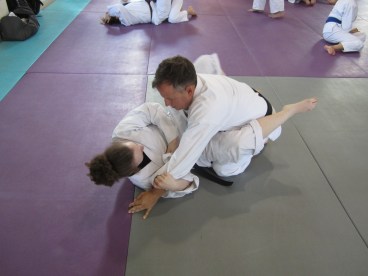
Hip Swivel

Throughout the seminar, Sensei Paul not only demonstrated his understanding of the body mechanics of ground techniques, but also demonstrated his ability as a teacher and coach. Sensei Paul taught individuals of varying backgrounds, such as BJJ, wrestling and karate. He explained techniques in a way that could be understood by individuals of any martial arts background. He is both patient and intellectual in his approach to teaching a group or an individual.

I feel we benefitted the most from Sensei Paul’s instruction in two ways. The first was through rolling. At the end of the seminar, we were given the opportunity to experiment with the variety of techniques we learned via two-minute grappling sessions. While rolling, we were told to go at different intensity levels, for example 60 percent, so everyone could practice in a safe and fun manner.

IMG_1466

The other opportunity we were given to gain knowledge was to ask questions. In Sensei Paul’s seminars, he gives everyone the opportunity to ask him about their experiences, what worked for them or didn’t work for them in the past as well as in the rolling session. In this way, Sensei Paul can tweak the techniques to fit the individual style, strengths and size of the student.

Although most karate practitioners do not pursue ground techniques, their standing technical knowledge operates on the same body mechanics as ground techniques.

You can observe the connective thread between standing and ground techniques through:

  • Kokutsu dachi and knee on belly position
  • Knee strike in comparison to both shiko-walk and “knee in guard” position
  • Hip rotation while doing a hip escape from the mount or transitioning to an arm bar from the guard

The body, of course, can only move in so many ways. We should expect that how we generate power standing can be applied the same way on the ground. Yet many karate practitioners continue to turn a blind eye to the importance of ground work and grappling,  even when common sense dictates that the principles of physics and body mechanics are applicable no matter what position someone is in.

The concepts found in our standing repertoire cannot be completely understood unless we recall karate’s true purpose: self-defence. To claim the art as self-defence and not address all the Habitual Acts of Physical Violence causes many to get stuck in one corner of their web. True martial artists must explore the concepts found in their systems with a critical gaze to see how the threads of their own practices connect with all other styles.

Looking for more striking inspiration? Follow The Martial Arts Muse on Facebook or Subscribe!
The Martial Arts Muse Tatami Promo

KU Quick Tip Posture for Drive

5 Ways to Promote Your Martial Art on YouTube

Did you know that YouTube reaches more U.S. adults between 18 and 34 than any cable network?

YouTube allows you to reach a greater audience in an engaging way with low costs. This is just one reason why YouTube is the perfect social media platform to showcase your martial arts club.

Here are just a few types of videos to promote your club and style over YouTube:

1)   Instructional Videos

Instructional videos show the type of material the students will be learning. For potential students this format gives insight into the instructor’s teaching style.

At the same time, these tutorial style videos act as review and give deeper insight into techniques for current students.

2)   Kata Applications

The average novice will look at a kata application video and see it as no more than a demonstration. However experienced martial artists, especially in the East Asian traditions, will have a great appreciation for functional applications.

A video containing what has become known as Bunkai in Karate is a great way to generate conversation about your style and build relationships in the online martial arts community.

3)   Testimonials

Testimonials act as social proof and are a key factor in building consumer trust. Video testimonials are also an effective way to attract a specific demographic, like children, women and seniors. When potential students see others like themselves, they are more likely to check out your school.

4)   Demonstrations

Demonstration videos are an awesome way to add entertainment value. These types of videos should showcase the best your martial arts school has to offer. This not only shows future students what they will one day learn, it also gives them something to aspire to.

5)   Competitions

If you are in a competitive martial art, like Brazilian Jujitsu or Tae Kwon Do, posting competition videos are another great way to build consumer trust. It will also attract potential martial arts students with a competitive edge.

Keep in mind, each video format will attract a different audience and potentially a different student base.

Be sure to know your goals and post quality content that will attract the ideal audience to your martial arts community both on and offline.

Thanks for reading!

Stay tuned for more ideas on how to promote your martial art on social media.