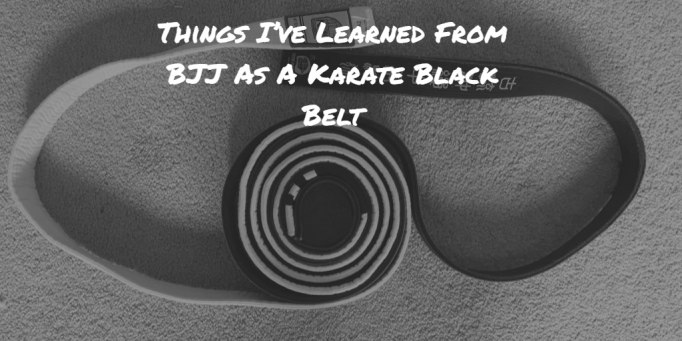
Bjj white belt, Karate black belt

Things I’ve Learned From BJJ As A Karate Black Belt

The first and most obvious thing I’ve learned attending BJJ classes is BJJ. But, if you’ve been involved in the martial arts as long as I have, you know that there is a lot more to gain than just technique. Often, these secondary benefits can outweigh the primary goal of acquiring a new skill.

From the beginning of my BJJ practice, I’ve been cognizant of how my past martial arts experiences can facilitate the acquisition of new information, and how that new information can enlighten my past.

With that in mind, let’s take a look at what I’ve gained as a BJJ white belt from the perspective of a Karate black belt.

#1 – I don’t know everything. . . Thank god!

Coming into BJJ, I already had a high-performance background in wrestling, and 18 years of Karate with Japanese Jujitsu thrown in. It’s safe to say that I had far greater experience than the average white belt in terms of technique and formalities.

I recall walking in with my white belt on. Not only was it tied correctly, but in such a way that it would not fall off while training, a dead giveaway to my instructor that I wasn’t completely new to the martial arts.

Despite this, and as one would expect, in my first class, I got my ass handed to me—thank god!

I’ve always enjoyed a good ass-kicking, and that day, I received it. It was a reminder that I didn’t know everything. It was also a sign that I was in the right place. Those around me had something to offer, and I would have lots to learn.

#2 – Reinforced Importance of Aggressive Resistance

Essentially, at the end of every lesson in BJJ, there is a rolling session. Rolls are a means to explore techniques you have learned and to apply them under pressure.  You aren’t really studying violence unless you pressure test. You can practice a technique over and over again, but if you don’t apply it under aggressive resistance, there’s no proof that it really works. I think this is one of the reasons that BJJ has served those in MMA so well. They’ve always made pressure testing a part of their regular practice, allowing them to enter an arena with the utmost confidence.

#3- A Background in Martial Arts Helps

Even if a martial art system offers a different emphasis, a background in any martial arts goes a long way.

I had the following going for me:

  • I didn’t feel silly or awkward putting on a gi
  • Having spent time in this male-dominant industry already, I wasn’t intimidated to be the only girl in the class
  • I already had excellent body awareness and was familiar with many of the movement patterns
  • I knew how to get hit and keep moving
  • I could immediately see the levers that make techniques work

I didn’t have to learn to overcome anything. Any obstacles that did arise were familiar ones. Because I felt more comfortable than the average white belt, it lent itself to an ease of adaptability in the context of BJJ.

#4 – Generalists Versus Specialists

The style of Karate that I currently practice is Koryu Uchinadi Kenpo Jitsu. In this style, we practice everything: submission, throws, chokes, percussive impacting, and of course, kata. In short, in Koryu Uchinadi we study violence.  Because violence has no specification in terms of techniques, we have a fairly wide curriculum that allows for specialization for those who choose. Our study is broad, which defines us as generalists.

Studying martial arts from a broad manner lends itself to many benefits

For example:

  • Understanding of contextual premise
  • A Comprehensive view of violence
  • Comfortable in most positions

Brazilian Jiujitsu practitioners are ground specialists. You don’t learn the proper mechanics of how to punch in a BJJ class, but as the Gracies have proven, you don’t necessarily need to. If we view BJJ as a web, all variables centre around a single point, the ground. While the opponent can kick, punch, grab, and so on, if the BJJ practitioner can grab you, they can control you.

Specialization also lends itself to unique benefits.

  • Hick’s Law—the idea that the more choices you have, the longer it will take to choose—is a non-issue
  • Highly proficient in a subset of techniques
  • Sub-specializations

#5 – The Principles Are All the Same

For most, we have 2 arms, 2 legs, torso and a head. The human body and physics don’t change based on the martial art you choose to study. My Sensei has always said, “if you close your eyes, let one karate black belt, one boxer and one Thai boxer punch you in the face, would you be able to tell the difference? Of course not, they would all hurt!”

The same would be true concerning an arm-bar applied by a BJJ, Sambo and Judo practitioner.

Often martial arts schools like to promote the idea that their method is better than another. The reality is the principles that govern the techniques of one school are exactly the same as any other. It’s a teacher’s understanding and how they communicate those principles that determine the strength of their methods.

The principles that govern ALL martial arts systems include:

  • Force
  • Momentum
  • The 5 ancient machines
    • Pulley
    • Wheel and Axel
    • Wedge/Inclined Plane
    • Screw (which is a variation on a wedge)
    • Lever
      • Class 1 (Load, Fulcrum, Effort)
      • Class 2 (Effort, Load, Fulcrum)
      • Class 3 (Load, Effort, Fulcrum)
  • Tool, Location, Intensity, Angle, Direction = The Application Formula

It is important to be reminded of this because looking at martial arts as a set of principles allows you to transcend individual techniques and see the practice as a whole.

Conclusion

In Japanese martial arts, we liken our study to a path. Often, we quote the following:

“There are many paths to the top of the mountain, but there is only one moon to be seen for those who achieve its summit.”

– Chinese Proverb

Over the years, I have walked several paths simultaneously, enjoying each new road as much as the next.  Taking the time to walk these unexplored pathways may initially require greater investment, but it’s has proven to show some useful shortcuts.

But as we all know, it’s not about the destination, it’s about the journey. Despite my background, I know my exploration of BJJ will offer many peaks and valleys that are yet to come. When I meet them, I look forward to greeting them like old friends.

Want To Be Good At Martial Arts? It’s About Time In.

“It’s not who’s good, it’s who’s left. It’s hours on the mat. If you put in the time, natural athlete or not, you’ll be a black belt. . . You just can’t quit.” – Chris Haueter

I love this quote. It touches on so many points that some people miss when pursuing the martial arts.

“It’s not who’s good, it’s who’s left.”

There’s always going to be someone better than you.

Perhaps you get beat by the same person at every tournament, or there’s a person in your club who seems to go through rank faster than you.

No matter the situation, some people, despite their talent, often quit. Their reason for quitting may stem from boredom because they don’t feel challenged. Alternatively, those who are identified as “talented” will quit from frustration when they eventually do face something truly challenging, but lack the experience to cope.

Those of us who have to work a little bit harder to maintain our skills organically learn the patience and persistence necessary to be a life long martial artist.

“It’s hours on the mat.”

There’s just no substitute for time. Martial arts isn’t like cramming for an exam, where you have the information accessible for a little while and then lose it immediately when you don’t need it any more. What you learn needs to become a part of you and accessible in an instant at a moment of complete surprise.

At the end of the day, the mat doesn’t lie and certainly knows how to tell time.

If you put in the time, natural athlete or not, you’ll be a black belt.

In life, some of us have a head start. Some parents put their children in physical activities at a very early age, and as a result, acquire the body awareness and skill to be better martial artists than those who haven’t.

But all skills can be learned and acquired with time, no matter an individual’s starting point. Yes, for those who haven’t been exposed to movement patterns that make for a good martial artist, it will take them longer, in many cases, much, much longer. But, if they put the time and mental energy that is necessary specifically for THEIR individual success, then they will attain the skill of a black belt eventually.

You just can’t quit.

If your goal is to be the best at your craft that you can possibly be, then quitting is never an option. Perfection is an illusion, but it’s only by continually practicing that we can come as close to perfection as humanly possible. And, when our goal is to be the best we possibly can be, then there is never an end in sight, no matter the rank we have or are hoping to achieve.

Conclusion

Whether you’re a serious competitor or just pursuing martial arts as a hobby, it’s all about how many quality hours of work you invest. I don’t care how long you’ve been in a club or how many months you’ve prepaid for. Sure, there will always be outliers. There are some people out there who will just never get it and there will always be people who pick things up easily. But for all of us who lie in between, it’s the time you spend working technique and the energy you expend to master it that determines your skill and rank. . .Or, at least, it should.

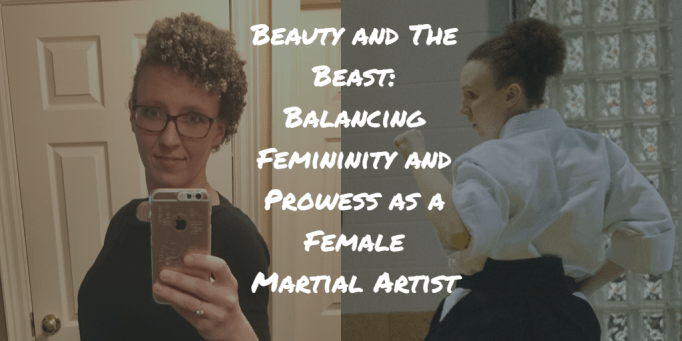
Beauty and The Beast: Balancing Femininity and Prowess as a Female Martial Artist

Beauty and the Beast was and is my favourite movie. I still get chills from the opening scene.

A tale as old as time, it tells the story of an unlikely romance between an intelligent, yet odd beauty and a rash, aggressive beast, that a little town, a quiet village, tries to squash with fire and pitch forks.

As a female martial artist, internally I feel this same tension between beauty and beast, the conflict between outward societal expectations of femininity and the inextinguishable aggression within.

I channel the forces of both beauty and beast, femininity and prowess, always simultaneously.

These forces are always in flux, and for each of us these ratios bend and play out in different ways.

I love physicality. I grew up watching pro wrestling. My brothers and I would act out the flying feats of Ray Mysterio and the dropping elbows of The Rock off our couch in the living room.

Often when family friends would drop by, they were surprised that I, a girl, would engage in such antics usually reserved for boys, “Wow! She jumps in there, too.”

At the same time, I loved barbies, dress up, and the colour pink.

I still love those things.

But I also loved Teenage Mutant Ninja Turtles, Arnold Schwarzenegger movies, and Hot Wheels.

Now, as an adult, I love martial arts and the prowess it expresses.

Now, as an adult, I love make-up and the femininity it expresses.

I love the feel of executing a good heel hook.

I love the feel of wearing a good pair of heels.

Females are often pressured to think that we need to choose between the two. To choose would be to deny an element that makes us whole, an element that makes us human. And, I think when we express femininity and prowess in a way that is true and complete to our nature that that’s where true beauty lies.

Enjoyed this post? Check out “A Good Training Partner Is Hard to Find“!

Title Image for Blog "Just Because You're Injured. . ."

Just Because You’re Injured. . .

Doesn’t mean you can’t participate.

With most injuries, you can still be an active participant in your martial arts community.

Recently I hurt my ribs, which restricts my participation in Karate, BJJ and Krav Maga.

But just because I sustained an injury doesn’t mean I can’t still participate in the community.

“The martial arts is a journey that goes beyond the cultivation of physical skill, and hones both mind and spirit.”

Instead of staying home from training, I grabbed my camera and took pictures of others working through the lessons.  This served my community by providing content for their social media feeds, aided in remembering the content presented, and my presence in the dojo allowed me to provide feedback to participants.

At events, I’ll often see my older colleagues grab a note pad and pen to take notes when there is a technique that doesn’t “jive” with their sore joints. In doing so, they can understand and remember the techniques so when they return to their own dojo, they can help coach those who are capable of such movements.

For those who are experienced enough, there’s always the option to help teach. Even if you can’t perform a technique in all circumstances, you can still talk someone through a movement or explain a concept aiding in the progression of those around you.

When you can’t physically perform a task, there’s always an option to make it an intellectual endeavor by taking notes and help instruct or a creative one by taking videos or photos.

But whatever you choose to do, make sure it’s in line with your goals. At the same time, always be cognizant of the limitations that injuries can have on you both physically and mentally. Some injuries can certainly take a larger mental toll than others, so do what’s best for you.

It’s easy to find reasons not to do something, but if there is will there is “the way”.

The choice is yours!

Enjoyed this post? Check out “Being A Good Uke; It’s Harder Than You Think”!

Bruising Easily, A Reflection on Martial Arts

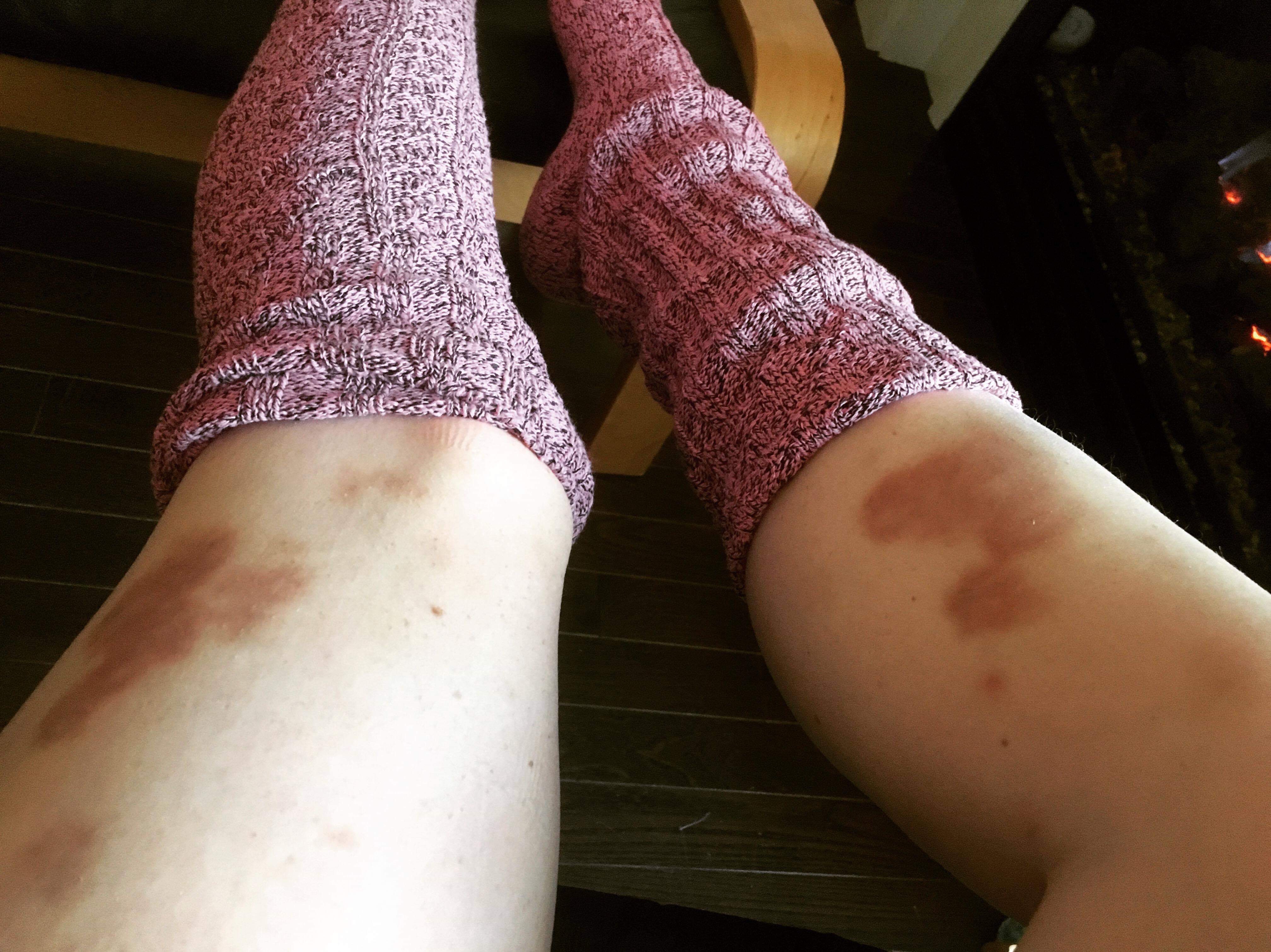
There are girls out there who use filters on Instagram to make their face look better. I use filters to accentuate the colour of my bruises.

Martial arts and bruising

I don’t wear this palette of black, purple and blue as a badge of honour; these spots are simply a natural representation of how the martial arts affect me.

That being:

“I face enough negative experiences to give me character, but not enough to make me callous.”

The martial arts force us to confront negative experiences on a daily basis and sometimes one experience may be more intimidating than another.

With time these experiences leave a lasting impression, or in the case of my bruises, a rather large imprint.

But these experiences are usually not enough to truly hurt us. They’re just sketches of what COULD harm us; shading that is easily erased by the next time we train.

A fine example of this may be an elbow to the face while grappling. We know such a thing could happen. We know that such a thing could happen in real life. But, when it does happen unexpectedly in the safe confines of a class, it leaves a lasting impression in our mind and most certainly on our body. However, if we were to let it affect us beyond acknowledging its possibility, occurrence and surprise, we would likely never return to the classes.

Accidents like an elbow to the face, a knee to the groin and a good ol’ poke in the eye are all common. But, it’s never enough to make us leave or feel fear. If anything it naturalizes the blows we are taught to face and the pain they can inflict, and often we even laugh in the face of it. But, unlike the real threat of violence, it doesn’t leave us callous (or at least it shouldn’t if you’re in the right school).

Receiving these ink blots of the skin builds a certain type of immunity to violence; it doesn’t hold the same influence it once did.


With time it develops our character. You learn these so-called “injuries” are only skin deep, can result from both hitting and being hit, and the sight of them is no longer a cause of concern for you.

So, perhaps my bruises are a badge of honour. They prove practice. They prove force. And, as long as they only occur on my arms and legs, it proves I’m pretty damn good at blocking.

Your body is your canvas. Your training is your brush and paint. Bruising, pain and discomfort is a natural consequence of our training and with each class you paint your own masterpiece. It is a natural consequence of the art and with each lesson the image you create becomes more vivid.

Enjoyed this post? Check out “Dojo Disillusionment”!


Friction in the Dojo: How It Can Move You Forward

Friction. . .

thomas-millot-316805-unsplash

It can be the thing that helps drive you forward. . .

It can be the thing that slows you down. . .

As yellow belts, my friend Tracy and I had a silent competition against each other.

Our Sensei told us that the only person we should compete against was ourselves.

“Os! Sensei!”

giphy1

In lip service, like so many still do, we professed to one another and our instructors that this was always our goal, to simply be better than we were the day before.

A selfish attempt to be more idyllic than the other.

When we stood next to each other in line, our eyes would always glance to the other.

Watching, sensing, checking. . .

giphy

“Is her horse stance lower than mine?”

“Did she do more push-ups than I?”

“Did the Sensei compliment her and not me?”

As these thoughts and insecurities arose in me, I later learned that she thought the same.

It was the unspoken friction that propelled us forward.

For everything she did well, I was committed to doing it. . .

better,

faster,

stronger,

than her.

And with that, Tracy would double her efforts in return.

In the presence of one another, our efforts were exponentiated. Our skill improved through the silent desire to be the best in the dojo, better than the other.

But. . .

One day, Tracy stopped attending classes. So, I was left  alone to to find another “Frienemy” to silently compete with.

As the years passed, there would be others. . .

Watching, sensing, checking. . .

Better, stronger, faster. . .

Wash, rinse, repeat. . .

giphy2

But, they would all eventually leave as well.

By the time I achieved my Shodan, there was no one left to compete with.

The Senpai above me were so far ahead, there was no competition there.

And, my students were not close enough yet to truly challenge me (although, I look forward to that day).

Without this traction, I could feel myself slowing down.

For the first time in my life, I had no one to compete with but myself.

giphy3

Where I once targeted my critical eye on those around me, I was now forced to point it at the one person I could neither defeat nor be defeated by: myself.

It was in that moment I understood what my Sensei was getting at when he said, “You should only compete with yourself.”

There is, of course, value in silently competing with those around you, as a type momentary motivation to challenge your physicality and fitness.

But, in the long run, you should define your success on your own terms. Each individual in the dojo has their own unique objectives. Sometimes people pursue martial arts for fitness, others for camaraderie, or just because they find it fascinating.

Would you want to compete against someone who is purely interested in the history of karate when your interest is biomechanics?

Of course not.

In this sense, it’s not so much about competing, but defining your unique objectives. Give yourself the recognition that you deserve. Observe the distance you’ve gone to achieve your goals. Have enough self-awareness to ask “Can I do better?” and to answer “I will do better”.

Now, when I step in line and look in the mirror, I sometimes see the gawky, awkward, teenage, yellow belt I once was and I wonder. . .

“Is her stance lower than mine?”

giphy4

Martial Arts & Swimming Alone

As a child, I was afraid of swimming in open water by myself; the vastness frightened me.

183499_4379613567_5589_n

I was afraid that the weed that tickled my feet would be the thing that pulled me under.

jong-marshes-458354-unsplash

I was afraid that if I turned away from the endless horizon that the shore that once harbored me would be gone.

I was afraid with no one there beside me I would slowly sink into the abyss, no one to hear my cries for help, no one to help me re-emerge.

Martial Arts And Swimming Alone Reach

For many, the martial arts generate this same fear.

You could spend a lifetime exploring its depths and never fully understand it all. There is SO much to learn; the knowledge is vast. It’s easy to feel insignificant, treading water, struggling to keep your head above water against its swells.

There are many who have changed styles of martial arts because of one reason or another. Perhaps the politics and drama was too much, you outgrew your teacher’s skill, or you just didn’t see its value anymore. In these moments, you must turn away from the shore, the place from which you came—often with uncertainty—and swim towards a new horizon.

In each of our dojos, we have to fight through the metaphorical weeds: an impatient student, an overbearing mother, a self-absorbed instructor. At first, these things can seem like a threat, but the energy lost trying to avoid these weeds can be better spent by simply swimming forwards.

When you enter these open waters you can jump feet first, or you can dive right in.

But, when you do, remember . . .

No matter the distance between you and the shore, it will always be there to harbor you.

tim-easley-318211-unsplash.jpg

No matter the depth of the abyss, there will always be a hand to reach to.

And, no matter the weed that tickles your feet, it will never break the surface.

But once you face this vast ocean on your own and swim further away from your shore, you’ll realize that all those who walk the path also swim the same ocean and reach for the same horizon.

But know now, the rewards that lie on the horizon just beyond your reach and your fear…

Will. Be. Glorious.

laib-khaled-324459-unsplash.jpg

Thanks for reading!

As a token of appreciation, you get 10% off at Submission Shark! Promo Code: THEMARTIALARTSMUSE

10% Off

Join us for the 2018 Koryu Uchinadi North American Gasshuku in Beautiful Cobourg, Ontario! Click here to learn more!

KU_IRKRS-3


You Invested In The Wrong One. . .

You know the one. . .

A Student

A student who showed so much promise. . .

With the ability to pick up movements with ease and grace,

An ability to strike and kick as if it was second nature, leaving you with the feeling you have found a prodigy.

You know the one. . .

A Teacher

A teacher who showed so much promise. . .

With skill and knowledge so far beyond your own.

A paradoxical ability to challenge and encourage you, leaving you with the feeling you’d be lost without them.

But then. . .

Something happens. . .

The masquerade ends. . .

And, something dark deep down seeps out from beyond their mask.

They are not what we hoped them to be. They never were.

You know the one. . .

A Student

A student who speaks wrongly behind your back

With the natural ability to lie and deceive;

A prodigy with the cloak and dagger.

You know the one. . .

A Teacher

A teacher who lacks moral stamina.

The ability to choose vice over virtue.

They submit to nothing, except their own temptations.

But perhaps the mask they once wore was not one of their choosing

It is a mask we projected.

We were so desperate to grasp at the hybrid of elegance and ugliness that we put what we desired most in the forefront only to watch it dissolve away, leaving you with this empty feeling. . .

You invested in the wrong one.

Post Script:

No matter the reason—whether it was simply a talented student who went off to university, a teacher who started teaching “chi- balls,” or something far more insidious—being disappointed by someone in whom you’ve made the careful decision to invest your time, energy and, dare I say, love is never easy. But, as the Buddha says, “all things are impermanent” and as that emptiness passes, you’ll find that in its place friendships with more dedicated students and respectable teachers will blossom far greater than the void that was left. Those are the people worth investing in.  

Guest Post: “The Instructor-Student Gap: Why Your Students Still Suck” by Josh Stewart

Any good instructor’s process is always under scrutiny. The instructor looks at the students and wonders, “Why aren’t they doing what I asked?” or “Is that really what I showed them?”

giphy

Self-doubt is a valuable tool in martial arts both as a student and as an instructor. As a student, when the instructor makes a correction or provides feedback, there should always be the assumption that you are the one doing it wrong. If that’s the baseline assumption, then if it’s not true, you have reminded yourself of something you are doing correctly, and if true, then you have found an area to fix.

As an instructor, this can be somewhat more difficult. The reality is that there will always be a gap between what you teach and what somebody else learns. It could be physiological differences, miscommunication, or varying learning styles that cause this discrepancy to exist.

Physiological Differences:

Age and injury account for a number of physical limitations that may prevent students from doing exactly what the instructor does, but there are also a number of other biological factors that affect how an individual performs a particular technique.

Flexibility, or lack thereof, has a vast effect on how the body moves. Stances and kicks are obvious areas where flexibility provides a greater range and may limit a student from copying exactly how an instructor executes a movement. Grappling is another area where strategy or technique selection can be largely determined by flexibility. For example, Eddie Bravo’s 10th Planet system is designed with the assumption of a certain range of motion, and someone without that capacity may struggle to emulate those exact sequences.

giphy1

However, I have also noticed that double-jointed students often have difficulty limiting their flexibility by contracting muscular groups effectively at the right times. Even a simple straight punch, executed by someone with a lot of flexibility, sometimes gives the appearance and feeling of being floppy when joints hyperextend without suitable muscular contraction to support the energy transfer.

Stature is another contributing factor. Bigger, more muscular people may rely on their size and strength advantage when working with a smaller partner, leading to neglect of correct footwork, positioning, or body mechanics because they can “get away with” doing the technique incorrectly—until they encounter a training partner their own size. Conversely, smaller students may have to supplement their techniques with extra kicks, knees, or groin slaps to help bring larger partners down to their own level. Otherwise, they may struggle to achieve the intended outcome because they simply can’t reach the targets designed in the training exercise.

Miscommunication:

As the word suggests, this occurs when one or both parties involved are not on the same page in regards to what is being asked. Any martial arts instructor who teaches kids knows that lack of listening or focus has a vast impact on this process, but it is certainly not limited to children.

Adults, especially advanced ones, tend to experience miscommunication because they believe that they already know the message being delivered. Again, the correct default for a student should be to assume they know nothing and are doing it all wrong, but naturally after several years of training, the ego may want us to assume otherwise.

fullsizeoutput_887

Of course, it takes two to tango. Instructors sometimes give vague or contradictory pieces of information about how a technique or strategy should be applied. Another source of miscommunication that can be blamed solely on the instructor is talking over the students’ heads. At times there may be too much technical jargon that learners will not be familiar with, in which case the verbal instruction may not transfer any useful information to the group. Instructors always need to remember who their audience is to ensure that the right level of detail is being provided at the right time in the learning process.

To limit miscommunication, creating an environment where it is safe to ask questions is vital. If a student asks for clarification and gets an abrupt, rude response, that will be the end of the process. Unfortunately an instructor’s ego is also involved in this process, often leading to the conclusion: “Well, I explained it clearly . . . What’s wrong with these students for not getting it right?” Just like the student, the instructor’s baseline assumption should be the opposite. If the students aren’t getting it, the onus should first be on the instructor to try again to deliver the lesson clearly and effectively.

Learning Styles:

Of course, there has been a lot of research into kinesthetic, auditory, and visual learning. The established reality is that, while we may rely more heavily on one rather than the other, each is a spectrum, and depending on what we are learning, we use each to varying degrees. In martial arts, we virtually always rely on them all: we listen and watch as the instructor presents the material, then we practice it physically.

Learning style also affects how an instructor delivers lessons in terms of how much context to give. Some learners are “big picture” oriented—they won’t understand the piece of a puzzle unless they know what the entire scope of the puzzle is. However, others are happy just to take one piece and practice it, and worry about the next step in the process when they get there. While one learner might be confused by being asked to deliver a technique without knowing what came before and what will come after it, another will be bored by the teacher’s long, unnecessary rant about the history and functionality of a certain sequence that they haven’t had the chance to practice yet.

fullsizeoutput_5c9

Body language is a key to understanding a student’s learning style. An auditory learner stands closely to the instructor and leans in to hang on every word; a visual learner re-positions to get the best angle to see what’s happening; a kinesthetic learner mimics the instructor as the movement is being demonstrated. Global learners may walk back to their partner shaking their heads or linger longer than others, hoping for more explanation. Analytic learners may look restless when the big picture is explained and will be the first one back to their partners.

In any group of students, there will typically be a standard distribution of students who will learn faster than average with less practice, those who will achieve proportionally to the amount of effort they expend, and those who are ultimately destined for failure despite their best efforts. The instructor’s role dictates catering to those in the second category. If students are struggling to perform the technique as being explained and demonstrated, the instructor should first look at the potential of his or her own failure before moving to the conclusion (although sometimes correct) that the student is the one responsible for missing the mark.

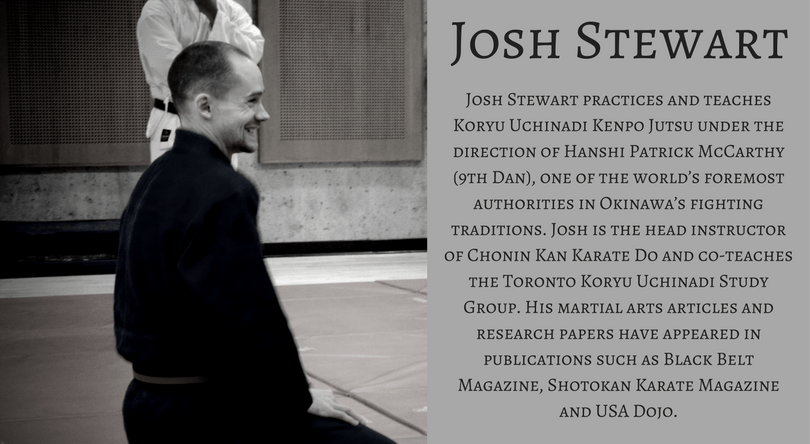
Author Bio Josh Stewart

Enjoyed this post? Follow The Martial Arts Muse on Facebook for more Martial Arts Musings!

The Martial Arts Muse Tatami Promo

Being A Good Uke; It’s Harder Than You Think

Have you ever watched your Sensei choose one individual over and over again to be his Uke and thought, “Why not me!?”

In any seminar or class, you’ll find the head Sensei will consistently pick the same individuals to work with when demonstrating techniques. I think many of us would love to “volunteer as tribute” and feel the glory of being at the front of the dojo with your head Instructor!

54jlduln5bowm

But, there are many reasons why some people are chosen more than others.

From time to time, an individual is chosen because of their size. A Sensei may choose the largest person in the room—usually to prove a point about technique vs. strength/size.

48xthdulxddeo

Sometimes an individual is chosen because of flexibility, so that the Sensei can execute the full extent of an armbar or leg lock without the individual tapping.

gbignlikts3gu

But usually, one is chosen as a demonstration Uke because they’re amongst the best in the room.

You would think that letting the teacher hurt you would be easy, that any dummy can do it!

But, not just any dummy, a very skilled dummy. . .

13vpdvincvvil2

To be a good Uke and especially an Uke for demonstrations, you literally have to know what you’re getting yourself into. By that I mean you have to be familiar with many, if not all, the possible positions the Sensei may put you in, sometimes without the Sensei even telling you what she/he will be applying. So, unless you have a crystal ball with you, you either have to have superb body awareness and biomechanical knowledge or completely memorized the curriculum.

The Sensei, like Goldilocks, is looking for someone that is not too hard or too soft.

They’re looking for an individual that will

  1. Comply and restrict at just the right moments and with just the right intensity
    • Nothing (and I do mean NOTHING!) is more annoying to a head Sensei than a Uke who anticipates a technique and gives an unrealistic reaction, like moving before the technique was actually applied, OR actively resists when the Sensei is demonstrating. The key here is to respond, not anticipate, the Uke must have a complete understanding of the intent of every technique that they are subject to and respond accordingly with enough resistance for the demonstration to run smoothly and realistically.
  2. Set a good technical example when they return a technique
    • The Uke must know how to receive, counter and execute techniques with the same speed, power and skill as the Sensei applying it. If the Uke does not adequately perform a technique, the lesson the Sensei is trying to teach could be lost and the entire group could end up doing the technique, counter or sequence completely wrong! (No pressure or anything!)
  3. Most importantly, make the head Sensei look good!
    • As an Uke, it is your responsibility for the demonstration to look as good as your body will physically allow because when you are asked to present with the Sensei (especially at a seminar), you have become a representative of that Sensei, an extension of their name/style.

AND

The Uke must do all of this while being submitted to various degrees of pain, being put in the most awkward of awkward positions and essentially getting the crap kicked out of them!

rxsfebozub3zc

So, the next time you ask “Why not me!?” remember we often overlook the skill of the Uke. Instead, concentrate on the small details the Uke demonstrates because getting the crap kicked out of you isn’t as easy as you think.