The Road Less Travelled Is Not Always A Road

“There are many paths to the top of the mountain. . .”

eberhard-grossgasteiger-338314

One night, I had a dream that I slid down a mountain and I was about to fall into the ocean. Before I hit the water, I caught onto something and started to climb back up. At this point, there were other people around me—most of which were people I loved and respected—and they were climbing faster than me and with bigger loads on their back; some were even carrying other people as they climbed upwards.  I was constantly losing my footing and slipping; I was afraid to fall, anxious to get to the top and frustrated that everyone else was doing better than me.

eberhard-grossgasteiger-424816.jpg

Then, I noticed a river flowing down the mountain beside me and a long time friend said to me, “Let’s swim up, it’s easier that way.” He jumped into the river and swam up, reaching the top before anyone else.

nathan-anderson-135242

I was afraid to follow because the current flowed downwards, but because I trusted him so much, I jumped in anyway and began to swim. I wasn’t sure in what style to swim in, because my friend reached the top with front stroke, I tried his way, but I went further down. So I started swimming doggie paddle; still didn’t work. Then, I went with breast stroke and found that I reached the top before everyone else.

ales-krivec-37519

Although unorthodox, I realized that by jumping into the river, I didn’t have to be afraid of falling anymore, because one cannot fall while in water. And even though I had to fight the current in the river, it was easier to flow upwards than if I had followed the methods of the people around me and I need not compete with them, because it is only through my own technique that I may reach the top of the mountain.

neven-krcmarek-175845

“. . .But there is only one moon to be seen for those who achieve its summit.”- Chinese Proverb

Karate and The Sunk Cost Fallacy

The sunk cost fallacy is when you make a decision based on the desire NOT to see your past investment go to waste, rather than on the best outcome.

Nowhere else do I see this phenomenon as much as in karate.

giphy

I have listened to many karate students and teachers explain to me that they are disenchanted with their current karate practice:

“The application practices are unrealistic.”

“The body movements are mechanical.”

“The teaching style is too militarized.”

giphy2

Yet when I ask, “Why don’t you quit or switch styles?”, there is always an excuse. Sometimes, they quote loyalty to their instructor or peers.

OR

It’s just the way they’ve always done it.

Denial-san at it’s best!

giphy7

The real reasoning is they cannot bear the thought that they’ve invested their entire life for a method that is now or always has been worthless.

It’s a security blanket that is worn, tattered and useless!

giphy3

I’ve also seen long-time students make no meaningful commitment to training, but show up for the last 15 minutes of class once a month, do a kata and leave, while claiming they are still passionate about martial arts. It is obvious their interest has faded and they’d be happier somewhere else.

giphy6

Why do they continue to come to a class when they aren’t getting anything from the class mentally, physically or even socially?

They hold on by their fingernails because they fear that if they completely stop, that all those years of real commitment and work will have been a waste.

As Julia Galif explains, “whatever you have already spent is called the sunk cost. It’s gone no matter what you do going forward.”

The irony is that the desire to not see your past investment go to waste makes you waste even more time clinging to something that you no longer enjoy.

My advice is to not waste any more time pretending martial arts is something you actually want to do. Put yourself in a place you want to be, even if that means leaving the Dojo behind.

giphy5

For instructors who are disenchanted, find a methodology that truly fits the outcomes you want to achieve. It may mean biting the bullet and starting over again from the beginning, but once you realize you are on the wrong path, the only option is to correct the course you are on.

For the students who have lost interest, your time hasn’t necessarily been wasted. The benefits of pursuing the fighting arts are far and wide and the lessons you’ve learned will always be with you. Remember, it’s better to have loved and left than to have never loved at all.

giphy4

Guest Post: “The Instructor-Student Gap: Why Your Students Still Suck” by Josh Stewart

Any good instructor’s process is always under scrutiny. The instructor looks at the students and wonders, “Why aren’t they doing what I asked?” or “Is that really what I showed them?”
giphy

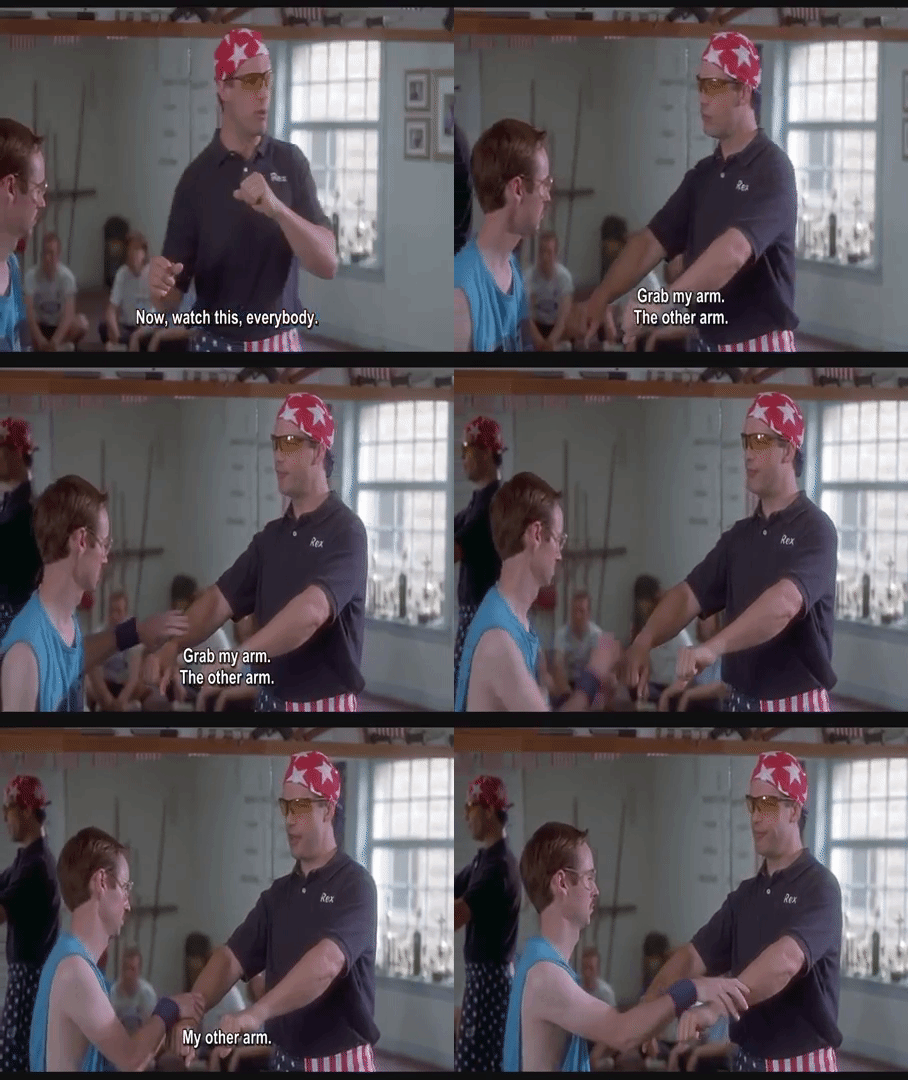
Self-doubt is a valuable tool in martial arts both as a student and as an instructor. As a student, when the instructor makes a correction or provides feedback, there should always be the assumption that you are the one doing it wrong. If that’s the baseline assumption, then if it’s not true, you have reminded yourself of something you are doing correctly, and if true, then you have found an area to fix.

As an instructor, this can be somewhat more difficult. The reality is that there will always be a gap between what you teach and what somebody else learns. It could be physiological differences, miscommunication, or varying learning styles that cause this discrepancy to exist.

Physiological Differences:

Age and injury account for a number of physical limitations that may prevent students from doing exactly what the instructor does, but there are also a number of other biological factors that affect how an individual performs a particular technique.

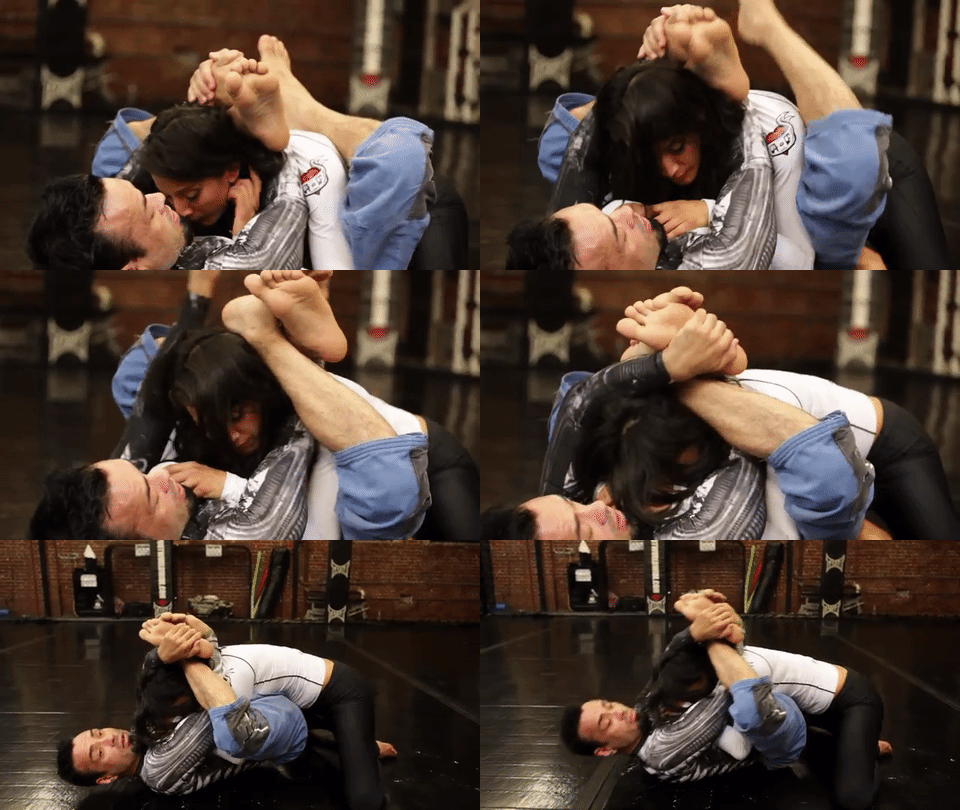
Flexibility, or lack thereof, has a vast effect on how the body moves. Stances and kicks are obvious areas where flexibility provides a greater range and may limit a student from copying exactly how an instructor executes a movement. Grappling is another area where strategy or technique selection can be largely determined by flexibility. For example, Eddie Bravo’s 10th Planet system is designed with the assumption of a certain range of motion, and someone without that capacity may struggle to emulate those exact sequences.
giphy1

However, I have also noticed that double-jointed students often have difficulty limiting their flexibility by contracting muscular groups effectively at the right times. Even a simple straight punch, executed by someone with a lot of flexibility, sometimes gives the appearance and feeling of being floppy when joints hyperextend without suitable muscular contraction to support the energy transfer.

Stature is another contributing factor. Bigger, more muscular people may rely on their size and strength advantage when working with a smaller partner, leading to neglect of correct footwork, positioning, or body mechanics because they can “get away with” doing the technique incorrectly—until they encounter a training partner their own size. Conversely, smaller students may have to supplement their techniques with extra kicks, knees, or groin slaps to help bring larger partners down to their own level. Otherwise, they may struggle to achieve the intended outcome because they simply can’t reach the targets designed in the training exercise.

Miscommunication:

As the word suggests, this occurs when one or both parties involved are not on the same page in regards to what is being asked. Any martial arts instructor who teaches kids knows that lack of listening or focus has a vast impact on this process, but it is certainly not limited to children.

Adults, especially advanced ones, tend to experience miscommunication because they believe that they already know the message being delivered. Again, the correct default for a student should be to assume they know nothing and are doing it all wrong, but naturally after several years of training, the ego may want us to assume otherwise.

fullsizeoutput_887

Of course, it takes two to tango. Instructors sometimes give vague or contradictory pieces of information about how a technique or strategy should be applied. Another source of miscommunication that can be blamed solely on the instructor is talking over the students’ heads. At times there may be too much technical jargon that learners will not be familiar with, in which case the verbal instruction may not transfer any useful information to the group. Instructors always need to remember who their audience is to ensure that the right level of detail is being provided at the right time in the learning process.

To limit miscommunication, creating an environment where it is safe to ask questions is vital. If a student asks for clarification and gets an abrupt, rude response, that will be the end of the process. Unfortunately an instructor’s ego is also involved in this process, often leading to the conclusion: “Well, I explained it clearly . . . What’s wrong with these students for not getting it right?” Just like the student, the instructor’s baseline assumption should be the opposite. If the students aren’t getting it, the onus should first be on the instructor to try again to deliver the lesson clearly and effectively.

Learning Styles:

Of course, there has been a lot of research into kinesthetic, auditory, and visual learning. The established reality is that, while we may rely more heavily on one rather than the other, each is a spectrum, and depending on what we are learning, we use each to varying degrees. In martial arts, we virtually always rely on them all: we listen and watch as the instructor presents the material, then we practice it physically.

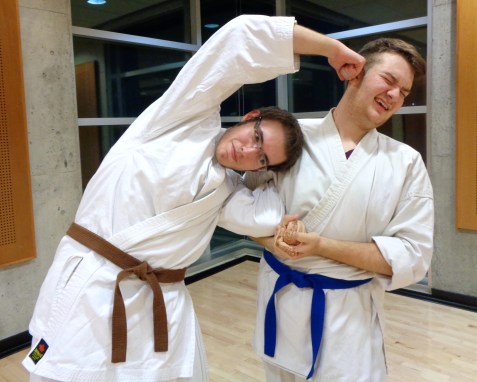
Learning style also affects how an instructor delivers lessons in terms of how much context to give. Some learners are “big picture” oriented—they won’t understand the piece of a puzzle unless they know what the entire scope of the puzzle is. However, others are happy just to take one piece and practice it, and worry about the next step in the process when they get there. While one learner might be confused by being asked to deliver a technique without knowing what came before and what will come after it, another will be bored by the teacher’s long, unnecessary rant about the history and functionality of a certain sequence that they haven’t had the chance to practice yet.
fullsizeoutput_5c9

Body language is a key to understanding a student’s learning style. An auditory learner stands closely to the instructor and leans in to hang on every word; a visual learner re-positions to get the best angle to see what’s happening; a kinesthetic learner mimics the instructor as the movement is being demonstrated. Global learners may walk back to their partner shaking their heads or linger longer than others, hoping for more explanation. Analytic learners may look restless when the big picture is explained and will be the first one back to their partners.

In any group of students, there will typically be a standard distribution of students who will learn faster than average with less practice, those who will achieve proportionally to the amount of effort they expend, and those who are ultimately destined for failure despite their best efforts. The instructor’s role dictates catering to those in the second category. If students are struggling to perform the technique as being explained and demonstrated, the instructor should first look at the potential of his or her own failure before moving to the conclusion (although sometimes correct) that the student is the one responsible for missing the mark.

Author Bio Josh Stewart

Enjoyed this post? Follow The Martial Arts Muse on Facebook for more Martial Arts Musings!

The Martial Arts Muse Tatami Promo

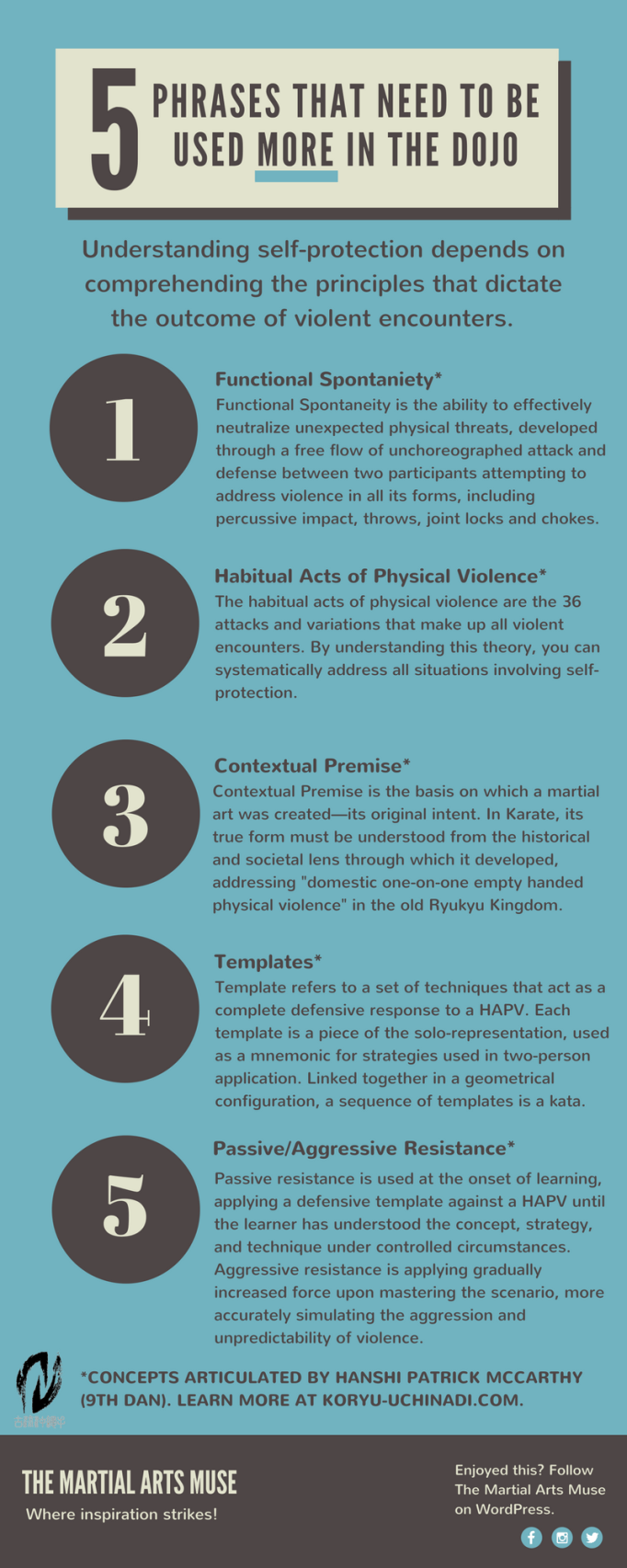
5 Phrases That Need To Be Used MORE In The Dojo

5 words that need to be used more in the Dojo-4

Enjoyed this post? Follow The Martial Arts Muse on Facebook for more Martial Arts Musings!

The Martial Arts Muse Tatami Promo

Dojo Gossip: Let’s Kick Some Scuttlebutt! (Part 1)

In Buddhism, they have a set of tenets called the Eightfold Path that serve as a guide for moral action and to relieve us from suffering. Amongst it’s precepts is “right speech,” which includes avoiding lying, hurtful speech and today’s topic, gossip!

buddha-quote

In the post Dojo Disillusionment, I touched on drama in the dojo. This topic received a strong reaction from the martial arts community.  It seems this gossip fuelled phenomenon is not unique to one person, club or style, but is universally experienced and fostered across MANY fighting systems around the globe.

The martial arts preach about the nature of respect, discipline and any other typical word or phrase that implies honour and we know very well that gossip and drama do nothing to help us in our individual progress. Then why is it that the martial arts seems to foster so much gossip? What is it about the martial arts that attract such drama?

By applying the insight of “Can Gossip Be Good?” (written by Knox College Psychology Professor Frank T. McAndrew) to the martial arts community, I hope to be able to provide plausible answers to these questions—in the end, helping us realign our compass along the path that can sometimes “become skewed in the mist of frivolous nonsense that seeps into our practice brought on by human inadequacies.”

Social Bonding

2015 Gasshuku Go KU

It’s strange, isn’t it? In an art where we constantly practice how to demolish the human body, we can build such meaningful and long-lasting relationships.

Just as overcoming adversity, whether physical or otherwise, can act as a form of social bonding, so can gossip. Ron Dunbar from the University of Liverpool says, “gossip is a mechanism for bonding social groups together, analogous to the grooming that is found in primate groups.”

According to Frank T. McAndrew, this type of social bonding helped our ancestors address problems such as “remembering who was a reliable exchange partner and who was a cheater, knowing who would be a reproductively viable mate and figuring out how to successfully manage friendships, alliances and family relationships.” Surely, we can all think of ways this applies to the martial arts.

“Reliable Exchange Partner”

For some, the term “reliable exchange partner” might stand out in the previous paragraph. Although McAndrew uses the phrase to refer to those who our ancestors might have had monetary investment in, as martial artists, we might think of those whom we exchange blows with, our training partners. At seminars or even our own classes, we take into consideration whether or not we can trust the people we work with.

We wonder:

“Can I work with this person and not get physically injured?”

“Is that person here just to be physical with the opposite sex?”

“Are they good at what they do?

“Can they help me improve?”

Where possible, we rely on those who have had previous experiences to help us guide our decision to work with specific people. Gossip, then, serves as a means of determining who will help us thrive in the martial arts, while at the same time avoid situations that could be detrimental to our safety; in other words, it acts as a means of self preservation and protection.

“Cheaters”

In the martial arts, those who are dedicated have a lifelong investment in their teachers, style and dojo. Hence, knowing whom McAndrew refers to as “cheaters” through gossip, we can learn who is loyal and will help in the progression and preservation of our dojos, its culture and the people who encompass it. 

new-belts

Perhaps you know people who try and cheat the system to attain a new rank, giving those who have the power to promote them the impression that they are training hard and consistently, when in reality they are amongst the lowest in skill, effort and attendance. Others may praise a teacher to his face and secretly poison his name behind his back. Gossip serves as a means of exposing these “cheaters” as unworthy exchange partners for the greater good of the community.

“Deep Trust”

Our relationships in the martial arts are heavily dependent on trust. Based on trust, we allow other people to come within millimeters of breaking our limbs and spend years of our lives investing in instructors who we believe know what’s best.

giphy

McAndrew goes on to say that “sharing gossip is a sign of deep trust because you are clearly signaling that you believe that this person will not use this sensitive information in a way that will have negative consequences for you; shared secrets have a way of bonding people together.”

As we see in the movies, the Master only shares his secret techniques with his most dedicated pupils; this is also true with gossip. When the instructor shares his experiences about instructors of other styles or dojos, he is not only doing so to help protect his pupil against “false prophets,” or those with low ethical standards, but also demonstrates to his pupil that he has faith in their discretion. It communicates to the student, just as learning the “secret technique” does, that this information is meant for them and them alone—in the end, building a stronger bond between pupil and instructor.

Human Beings First

Ultimately, we are human beings first and martial artists second. As human beings, we are social creatures; we crave acceptance and deep social bonds. Gossip, in it’s most innocent form, is simply a form of social bonding. It helps build trust amongst those in our dojos. We share the appropriate information to help others protect against potential physical or emotional threats that can occur in a seminar, tournament or class. This act also serves as a means of preserving those who share our values and isolate those who are untrustworthy or disloyal. In doing so, we create a community of like-minded individuals built on trust and friendship, where we can practice our art safely and free of fear.

Yet . . .

As we all know, there is a very dark side to gossip, used as a means of manipulation and deception. In the upcoming blog, Dojo Gossip Part 2, I’ll explore how the dark side of gossip is a reflection of ego and thrives in the martial artists’ competitive natures, which we so often ignore.

A Good Training Partner Is Hard to Find

There you are. . .

At your first seminar with a big, important Sensei. . .

Once you enter the dojo, you start to size up the Karate folk around you—wondering what rank they are, how long they’ve trained and with whom.

Then. . .

The Sensei says “Partner up!”

You look around at your options and you think. . .

“That partner looks too hard. . .”

“That partner might also be too hard. . .”

“That partner looks too soft. . .”

“Ah. . . That partner looks juuuuust riiiight!”

But somebody stole them!

Suddenly, you’re paired with the 6’7” 400lb reincarnation of King Kong! Which might be fine for some things, but not necessarily the best-case scenario for learning throws or ground work, especially when you’re significantly smaller.

giphy8

Sure, you don’t always have a choice on who you partner with, but if you did have the choice, who would be the ideal partner to get the most out of your training?

giphy9

1. They’re better than you are and challenge you in the right way.

giphy3

If possible, you want to work with someone who is better than you are and can pick up on your mistakes. They won’t allow you to get away with being lazy or doing things incorrectly.  If you do something wrong, they call you on it. They know how to build you up from passive resistance to aggressive resistance.

2. They’re a similar size.

the-shining

When first learning a new exercise or principle, it’s ideal to be able to focus on execution alone without any further barriers which can arise with someone who is a lot bigger or smaller than you are. For example, if you’re working with someone taller than you, it can sometimes be hard to find the right leverage when their limbs are so much longer.

3. They are trying to learn (Not Compete!)

giphy10

They’re not trying to prove themselves, but to IMPROVE themselves and appreciate the learning process. They work WITH you through the learning process, rather than use you as means to impress the head Sensei or make themselves look good and feel better about themselves.

4. They have good hygiene

giphy2

I realize this one is a little strange. But, we all know it’s true! The last person anyone wants to work with is the guy who hasn’t washed his gi in a week, has bad breath or hasn’t clipped their finger and toenails.

5. They have fun!

giphy4

If you’re not having a good time, what’s the point? The best partners don’t just know how to work hard, but have fun and laugh at their mistakes.

This isn’t to say that you shouldn’t work with different sizes, ages and levels; there’s plenty of value in doing so and should be included in the training process, which I touch on in Lady Looks In a Mirror – Part 1.

However, in the initial learning stage of any technique or concept, especially if you have a full day of training ahead of you, it’s best to have a partner who can push you to improve in a way that is both fun and safe.

So, choose wisely!

giphy11

Dojo Disillusionment

The martial arts world attracts strong egos, big politics and more drama than a high school play.

Maybe, someone received a rank that you felt they didn’t deserve or someone of high esteem lacks what martial arts writer Dave Lowry calls “moral stamina.” Perhaps, there’s constant gossip and you hear more about the people training than about the skills you should be mastering.

Because of this, at some point, you may feel disillusioned and disheartened. You might even have the urge to quit and think “I don’t need this drama in my life. If this is what the martial arts attract, why am I still doing this?”

That is the question, isn’t it? Why am I doing this?

Japanese martial arts have been likened to a path. As many of us know, the term “do” is attached at the end of martial arts, like Judo and Kendo, that means “the way.” This suggests that the martial arts is a journey that goes beyond the cultivation of physical skill, and hones both mind and spirit.

There are many things that attract us to the martial arts when we first begin our journey. Some pursue the martial arts for self-defense, physical fitness, to avoid boredom and even just for a sense of community.

But, there’s something beyond physical reasons that makes us return to the dojo time and time again. It’s an intangible, not qualified by how hard you kick or the belt you wear.

Koryu Uchinadi Black Belt

Something more. . .

Something deeply personal. . .

Something else. . .

It’s the calm that radiates through the dojo when you’re the first and only person in there practicing.

It’s the final breath of your kata, when you know it’s the best you’ve ever done it, but bow with the knowledge it will never, ever be perfect.

It’s the effortlessness in which someone slams to the floor when you get a throw JUST right.

It is the moments that lie between aggression and tranquility. A harmonious combination of our most animal nature with our greatest serenity that paradoxically brings us into a frame of being that transcends words and our human imperfections.

giphy1

An internal stillness propelled by breath and what I call a “return to centre.”

It’s sometimes easy for our compass to become skewed in the mist of frivolous nonsense that seeps into our practice brought on by human inadequacies.

So, when you lose your way along the path, focus on the most basic of human functions, breathe and return to centre.

It’s in that moment you realize there was no trick of the light. . .

No magical unveiling. . .

And, there was no illusion to begin with.

giphy


You Failed Your Grading; What’s Next?

So, you went for your next belt and you failed!

giphy1

But, just because you failed, doesn’t mean you should lose sight of your purpose; rain, after all, is just a falling cloud. . .

And, everything that falls can rise again!

giphy2

I mean, we’ve all been there. You don’t know what went wrong. . .

Maybe. . .

You were truly ready, but just choked—mentally unprepared.

Maybe. . .

You think you’re better than you actually are—a hard truth.

Maybe. . .

You worked hard, but just didn’t pay enough attention to the details—damn those details!

No matter the reason, your following actions should be the same. . .

1. Listen, REALLY Listen.

giphy3

In my experience, students fail to pick up on the specifics of a lesson because they perform what they perceive to be the right thing and focus more on pleasing the Sensei rather than actually listening to what’s being asked.

The conversation usually goes like this. . .

Sensei: I’d like you make your stance wider, so that you have a better base for. . .

Student: (Cuts off Sensei, changes stance slightly). Like this Sensei!? 

Sensei: No, not quite. I’d like to see you have your… 

Student: (Cuts off Sensei, makes stance even more wrong). LIKE THIS SENSEI!?

Sensei: No, I want you to put. . . 

Student: (Cuts off Sensei, stance incomprehensively wrong). LIKE. THIS. SENSEI!?

Sensei: (Mental face palm). No. 

So, really listen to what the Sensei is trying to tell you, let it sink in, then try, try again.

2. Remember it’s about the journey, not the destination. 

A Zen Proverb says, “When you have one eye on the goal, you only have one eye on the path.” The point it’s trying to make is that one should give their full attention to the steps to achieve the goal, not on the goal itself.

I’ve had many students ask about belts, usually concentrating on what they need to know to receive one or when and where the “test” will be. Yet, if they just focused on the things they need to work on to reach their goal, they would achieve it as a natural consequence of following each step of their journey.

giphy4

I know we’ve all heard this and it usually gets across. . . Until we have to be graded, that is.

It’s not only true in class, but during the grading as well. When you focus on each step and not the result, you’ll find that your nerves melt away.

giphy6

3. “Train Hard, Suck Less”

This saying was coined by my Calgary-based teacher, Sensei Cody Stewart. Simple and almost crude in its phrasing, its meaning is of great value. When you train, “train hard” to the best of your ability and with your full attention.  And, “suck less”, a humble expression of success, is both an act and a result of your focus and work ethic.

Sensei Cody Stewart

Although there are many paths to success, remember that failure is a key part of the learning process.

In reality, as my first Sensei once said, “There’s no failing in karate” as long as you’re always progressing. And as long as you’re always moving forward, that is success, no matter the belt you wear.

So, just keep training!

giphy


Kama Connections with Sensei Darrin Johnson

“A lethal weapon of self-defense, Ryukyuan kobudo evolved through the application of combative principles to a myriad of domestic objects that were readily available for use as weapons.” – Hanshi Patrick McCarthy, Ancient Okinawan Martial Arts 

Kama Seminar: April 31st – May 1st

At Sensei Darrin Johnson’s seminar, hosted by Renshi Mike Coombes at Hatsuun Jindo Martial Arts, students from around the Greater Toronto Area were introduced to one of the Sensei Darrinclassical Okinawan weapons, kama.

Sensei Darrin is a long time practitioner of Yamane Ryu and Koryu Uchinadi. In his seminar, he guided us through the kama kata Koryu No Nicho Gama.

Kama Kata: Koryu No Nicho Gama

Movements:

Koryu No Nicho Gama has a unique embusen, like that of an asterisk. Because of this, it also has intricate foot work, literally keeping you on your toes. It utilizes all possible sides of the weapon, which demands one be very familiar with all the ways to handle this tool. Also, this particular kata is far more physical than one might expect from a Kobudo form, including jumps and quick movements from kneeling to standing.

Applications:

No Koryu Uchinadi-based seminar would be complete without applications. Sensei Darrin left his audience in awe with his innovative applications using the kama, which included joint locks, chokes, tegumi and even throws.

Concepts:

1. Hooking

The kama shouldn’t just be looked at as a weapon meant for cutting, but rather like a sharp extension of the hand, that can be used to assist in any type of hooking motion, such as an arm drag.

Kama Applications

2. Striking

The blunt edge of the kama and the butt of the handle can both be used for striking vital areas.

Josh working through Koryu No Nichi Gama


3. Tools

Modern Western tools can be used in the same fashion as the kama, like a hammer or small axe.

Sensei Darrin is a big proponent of the idea of “Human Ryu,” the universal style. Because all human beings have two arms, two legs, a head and torso, we’ll all move in similar ways and produce power in the same way whether we are empty-handed or armed.

Throughout the seminar, this was the number one theme. Sensei Darrin emphasized this point by comparing karate and weaponry to other sports. He explained that the body mechanics a shot-putter would use to build centrifugal force is the same as when rotating to strike in the kata.

Sensei Darrin above all else is an excellent communicator and draws on historical context to assist in the teaching process. Studying weaponry, such as the kama, helps us to build a better understanding of where our art comes from and the context in which it was developed, while also helping to have a greater understanding of body mechanics.

Inspiration can strike anywhere! Don’t miss out! Check out The Martial Arts Muse on Facebook or Subscribe!

The Martial Arts Muse Tatami Promo

April’s Video of the Month: Master Ken

Carol Burnett said that “comedy is tragedy plus time.”

This is what I think of when I watch Enter the Dojo’s Master Ken.

Why do martial artists of every style watch and enjoy Enter The Dojo, when almost all our arts have been noted as “Bullshit?”

Well. . . Because it’s true!

For every legitimate martial artist out there with an understanding of body mechanics and the reality of violence, there’s dozens who have no idea what they are doing.

Master Ken’s satirical style, Amerido-te, embodies the shortcomings that all martial arts styles are subject to and, through its comedy, criticizes the unwavering dedication and naive devotion that many martial artists display.

This particular episode calls attention to the sport elements of BJJ, where in practice one always has the option of tapping – an unrealistic strategy for a street encounter.