Dojo Disillusionment

The martial arts world attracts strong egos, big politics and more drama than a high school play.

Maybe, someone received a rank that you felt they didn’t deserve or someone of high esteem lacks what martial arts writer Dave Lowry calls “moral stamina.” Perhaps, there’s constant gossip and you hear more about the people training than about the skills you should be mastering.

Because of this, at some point, you may feel disillusioned and disheartened. You might even have the urge to quit and think “I don’t need this drama in my life. If this is what the martial arts attract, why am I still doing this?”

That is the question, isn’t it? Why am I doing this?

Japanese martial arts have been likened to a path. As many of us know, the term “do” is attached at the end of martial arts, like Judo and Kendo, that means “the way.” This suggests that the martial arts is a journey that goes beyond the cultivation of physical skill, and hones both mind and spirit.

There are many things that attract us to the martial arts when we first begin our journey. Some pursue the martial arts for self-defense, physical fitness, to avoid boredom and even just for a sense of community.

But, there’s something beyond physical reasons that makes us return to the dojo time and time again. It’s an intangible, not qualified by how hard you kick or the belt you wear.

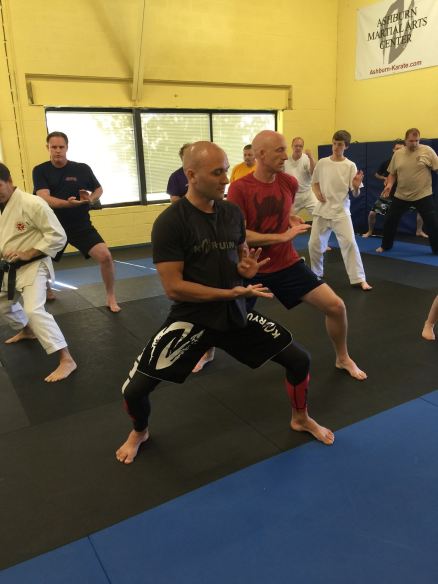
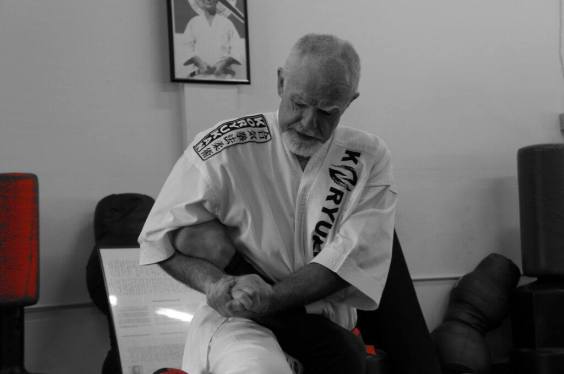
Koryu Uchinadi Black Belt

Something more. . .

Something deeply personal. . .

Something else. . .

It’s the calm that radiates through the dojo when you’re the first and only person in there practicing.

It’s the final breath of your kata, when you know it’s the best you’ve ever done it, but bow with the knowledge it will never, ever be perfect.

It’s the effortlessness in which someone slams to the floor when you get a throw JUST right.

It is the moments that lie between aggression and tranquility. A harmonious combination of our most animal nature with our greatest serenity that paradoxically brings us into a frame of being that transcends words and our human imperfections.

giphy1

An internal stillness propelled by breath and what I call a “return to centre.”

It’s sometimes easy for our compass to become skewed in the mist of frivolous nonsense that seeps into our practice brought on by human inadequacies.

So, when you lose your way along the path, focus on the most basic of human functions, breathe and return to centre.

It’s in that moment you realize there was no trick of the light. . .

No magical unveiling. . .

And, there was no illusion to begin with.

giphy


You Failed Your Grading; What’s Next?

So, you went for your next belt and you failed!

giphy1

But, just because you failed, doesn’t mean you should lose sight of your purpose; rain, after all, is just a falling cloud. . .

And, everything that falls can rise again!

giphy2

I mean, we’ve all been there. You don’t know what went wrong. . .

Maybe. . .

You were truly ready, but just choked—mentally unprepared.

Maybe. . .

You think you’re better than you actually are—a hard truth.

Maybe. . .

You worked hard, but just didn’t pay enough attention to the details—damn those details!

No matter the reason, your following actions should be the same. . .

1. Listen, REALLY Listen.

giphy3

In my experience, students fail to pick up on the specifics of a lesson because they perform what they perceive to be the right thing and focus more on pleasing the Sensei rather than actually listening to what’s being asked.

The conversation usually goes like this. . .

Sensei: I’d like you make your stance wider, so that you have a better base for. . .

Student: (Cuts off Sensei, changes stance slightly). Like this Sensei!? 

Sensei: No, not quite. I’d like to see you have your… 

Student: (Cuts off Sensei, makes stance even more wrong). LIKE THIS SENSEI!?

Sensei: No, I want you to put. . . 

Student: (Cuts off Sensei, stance incomprehensively wrong). LIKE. THIS. SENSEI!?

Sensei: (Mental face palm). No. 

So, really listen to what the Sensei is trying to tell you, let it sink in, then try, try again.

2. Remember it’s about the journey, not the destination. 

A Zen Proverb says, “When you have one eye on the goal, you only have one eye on the path.” The point it’s trying to make is that one should give their full attention to the steps to achieve the goal, not on the goal itself.

I’ve had many students ask about belts, usually concentrating on what they need to know to receive one or when and where the “test” will be. Yet, if they just focused on the things they need to work on to reach their goal, they would achieve it as a natural consequence of following each step of their journey.

giphy4

I know we’ve all heard this and it usually gets across. . . Until we have to be graded, that is.

It’s not only true in class, but during the grading as well. When you focus on each step and not the result, you’ll find that your nerves melt away.

giphy6

3. “Train Hard, Suck Less”

This saying was coined by my Calgary-based teacher, Sensei Cody Stewart. Simple and almost crude in its phrasing, its meaning is of great value. When you train, “train hard” to the best of your ability and with your full attention.  And, “suck less”, a humble expression of success, is both an act and a result of your focus and work ethic.

Sensei Cody Stewart

Although there are many paths to success, remember that failure is a key part of the learning process.

In reality, as my first Sensei once said, “There’s no failing in karate” as long as you’re always progressing. And as long as you’re always moving forward, that is success, no matter the belt you wear.

So, just keep training!

giphy


Being A Good Uke; It’s Harder Than You Think

Have you ever watched your Sensei choose one individual over and over again to be his Uke and thought, “Why not me!?”

In any seminar or class, you’ll find the head Sensei will consistently pick the same individuals to work with when demonstrating techniques. I think many of us would love to “volunteer as tribute” and feel the glory of being at the front of the dojo with your head Instructor!

54jlduln5bowm

But, there are many reasons why some people are chosen more than others.

From time to time, an individual is chosen because of their size. A Sensei may choose the largest person in the room—usually to prove a point about technique vs. strength/size.

48xthdulxddeo

Sometimes an individual is chosen because of flexibility, so that the Sensei can execute the full extent of an armbar or leg lock without the individual tapping.

gbignlikts3gu

But usually, one is chosen as a demonstration Uke because they’re amongst the best in the room.

You would think that letting the teacher hurt you would be easy, that any dummy can do it!

But, not just any dummy, a very skilled dummy. . .

13vpdvincvvil2

To be a good Uke and especially an Uke for demonstrations, you literally have to know what you’re getting yourself into. By that I mean you have to be familiar with many, if not all, the possible positions the Sensei may put you in, sometimes without the Sensei even telling you what she/he will be applying. So, unless you have a crystal ball with you, you either have to have superb body awareness and biomechanical knowledge or completely memorized the curriculum.

The Sensei, like Goldilocks, is looking for someone that is not too hard or too soft.

They’re looking for an individual that will

  1. Comply and restrict at just the right moments and with just the right intensity
    • Nothing (and I do mean NOTHING!) is more annoying to a head Sensei than a Uke who anticipates a technique and gives an unrealistic reaction, like moving before the technique was actually applied, OR actively resists when the Sensei is demonstrating. The key here is to respond, not anticipate, the Uke must have a complete understanding of the intent of every technique that they are subject to and respond accordingly with enough resistance for the demonstration to run smoothly and realistically.
  2. Set a good technical example when they return a technique
    • The Uke must know how to receive, counter and execute techniques with the same speed, power and skill as the Sensei applying it. If the Uke does not adequately perform a technique, the lesson the Sensei is trying to teach could be lost and the entire group could end up doing the technique, counter or sequence completely wrong! (No pressure or anything!)
  3. Most importantly, make the head Sensei look good!
    • As an Uke, it is your responsibility for the demonstration to look as good as your body will physically allow because when you are asked to present with the Sensei (especially at a seminar), you have become a representative of that Sensei, an extension of their name/style.

AND

The Uke must do all of this while being submitted to various degrees of pain, being put in the most awkward of awkward positions and essentially getting the crap kicked out of them!

rxsfebozub3zc

So, the next time you ask “Why not me!?” remember we often overlook the skill of the Uke. Instead, concentrate on the small details the Uke demonstrates because getting the crap kicked out of you isn’t as easy as you think.

May’s Video of the Month: Michael Jai White

Michael Jai White is an actor that has starred in movies such as Black Dynamite and Blood and Bone. He is also a director, writer and a superb martial artist!

Michael Jai White, a student of Bill “Superfoot” Wallace, was even voted Black Belt Magazine’s 2014 Man of the year.

In this video, he says that “boxers are taught how to throw a flawed punch” and beautifully demonstrates the importance of moving in a straight line with the late Kimbo Slice.

Humorously surprising, Kimbo with his MMA background just can’t keep up with Michael’s karate punch. In doing so, he proves you don’t have to be fast if you just move in a straight line.

Check it out!

Kama Connections with Sensei Darrin Johnson

“A lethal weapon of self-defense, Ryukyuan kobudo evolved through the application of combative principles to a myriad of domestic objects that were readily available for use as weapons.” – Hanshi Patrick McCarthy, Ancient Okinawan Martial Arts 

Kama Seminar: April 31st – May 1st

At Sensei Darrin Johnson’s seminar, hosted by Renshi Mike Coombes at Hatsuun Jindo Martial Arts, students from around the Greater Toronto Area were introduced to one of the Sensei Darrinclassical Okinawan weapons, kama.

Sensei Darrin is a long time practitioner of Yamane Ryu and Koryu Uchinadi. In his seminar, he guided us through the kama kata Koryu No Nicho Gama.

Kama Kata: Koryu No Nicho Gama

Movements:

Koryu No Nicho Gama has a unique embusen, like that of an asterisk. Because of this, it also has intricate foot work, literally keeping you on your toes. It utilizes all possible sides of the weapon, which demands one be very familiar with all the ways to handle this tool. Also, this particular kata is far more physical than one might expect from a Kobudo form, including jumps and quick movements from kneeling to standing.

Applications:

No Koryu Uchinadi-based seminar would be complete without applications. Sensei Darrin left his audience in awe with his innovative applications using the kama, which included joint locks, chokes, tegumi and even throws.

Concepts:

1. Hooking

The kama shouldn’t just be looked at as a weapon meant for cutting, but rather like a sharp extension of the hand, that can be used to assist in any type of hooking motion, such as an arm drag.

Kama Applications

2. Striking

The blunt edge of the kama and the butt of the handle can both be used for striking vital areas.

Josh working through Koryu No Nichi Gama


3. Tools

Modern Western tools can be used in the same fashion as the kama, like a hammer or small axe.

Sensei Darrin is a big proponent of the idea of “Human Ryu,” the universal style. Because all human beings have two arms, two legs, a head and torso, we’ll all move in similar ways and produce power in the same way whether we are empty-handed or armed.

Throughout the seminar, this was the number one theme. Sensei Darrin emphasized this point by comparing karate and weaponry to other sports. He explained that the body mechanics a shot-putter would use to build centrifugal force is the same as when rotating to strike in the kata.

Sensei Darrin above all else is an excellent communicator and draws on historical context to assist in the teaching process. Studying weaponry, such as the kama, helps us to build a better understanding of where our art comes from and the context in which it was developed, while also helping to have a greater understanding of body mechanics.

Inspiration can strike anywhere! Don’t miss out! Check out The Martial Arts Muse on Facebook or Subscribe!

The Martial Arts Muse Tatami Promo

April’s Video of the Month: Master Ken

Carol Burnett said that “comedy is tragedy plus time.”

This is what I think of when I watch Enter the Dojo’s Master Ken.

Why do martial artists of every style watch and enjoy Enter The Dojo, when almost all our arts have been noted as “Bullshit?”

Well. . . Because it’s true!

For every legitimate martial artist out there with an understanding of body mechanics and the reality of violence, there’s dozens who have no idea what they are doing.

Master Ken’s satirical style, Amerido-te, embodies the shortcomings that all martial arts styles are subject to and, through its comedy, criticizes the unwavering dedication and naive devotion that many martial artists display.

This particular episode calls attention to the sport elements of BJJ, where in practice one always has the option of tapping – an unrealistic strategy for a street encounter.

The Web Master: Spinning Concepts with Sensei Paul Lopresti – Part 2

It’s better to have a tool and not need it than need a tool and not have it.

This point summarizes the necessity of adding grappling to our fighting repertoire. And as I mentioned in the first part of this series based on my learning experience with Sensei Paul Lopresti, grappling is a common aspect of self-defence overlooked by many karate practitioners. I find this especially frustrating because so many kata techniques are applicable on the ground, as illustrated in my previous discussion of kokutsu dachi and knee on belly position.

Sensei Paul Seminar-Group

Another standing technique found in karate and other striking arts is the hiza geri (knee). If someone is properly executing a hiza geri with all their body weight moving into the technique and the hips driving forward, one can very much see the mechanical similarity of the hips in shiko-walk.

The shiko-walk is a common grappling technique used in a double leg take down or the knee cutter guard pass to kesa-gatami, in which you press your knee onto the inside of the opponent’s thigh.

With that said, Sensei Paul spun further applications of hiza-geri through his presentation of a ground drill of his own creation, completely committed to the bottom position, called Ura Ne-Waza. Based on my understanding, the creation of the drill was a critique of common grappling practices. Most BJJ clubs teach grappling from a superior top position and rarely address ways of being successful while on one’s back.

The inspiration for ura ne-waza was one of Sensei Paul’s female students. She constantly found herself on her back against bigger opponents—the type of opponent a woman is most likely to find herself against. With ura ne-waza, students can protect themselves against larger opponents by using various restraining techniques and submissions, like the guillotine or kimura, from their back.

Jen And Anthony

One position in the drill is called “knee in guard,” which uses the exact same body mechanics of a standing knee strike or shiko-walk.

In this position you stick to the opponent’s body by:

  • Under-hooking the left arm with your right arm and grabbing the opponents right wrist with your left hand
  • Pressing your left knee into the crevice of the elbow and bracing the bottom of the left foot on the right side of the opponent’s hip.

Josh And Ray

In doing the “knee in guard” position, you prevent the opponent from attempting a series of punches towards the head. It also acts as a potential transition into a multitude of submissions, such as omo-plata or the kimura.

Through these controlling positions, I learned that as the opponent struggles like prey within a web, you have a better sense of where they will turn next and can capitalize on their position.

Also, the hip rotation used to generate power in all striking techniques, strongly emphasized in Koryu Uchinadi Kenpo Jutsu, is another way to create space to escape holds and to transition into other submissions on the ground.

For example, in transitioning to the guard when the opponent is in a mount, explosive hip movement is paramount to accomplishing an escape. This movement is comparable to expanding into any standing striking technique. The feet plant on the floor as the arms push the opponent’s knee out, and one side of the hip drives forward while the other side retracts back, just like a gyaku-tsuki.

Furthermore, the strength of hip and core rotation is a necessity for all transitional movements. The ability to interweave a series of movements, such as how you move into your arm bar or your kimura from the guard, determines your success. Whenever there is movement, there is potential for space, and with space comes the potential for the opponent to escape or counter your efforts.

As I learned while going through Sensei Paul’s arm bar and kimura series, knowing how to create and limit space is fundamental. In the arm bar and kimura sets, Sensei Paul taught several different ways of getting into these techniques. The web of fighting starts when we are given several different options from a single position. In doing so, we learned to recognize specific situations that could allow us to transition from the guard to our desired submission. As we moved from the guard to our submission, we integrated a hip swivel to adjust angles and isolate the joint we were attacking, necessitating that we rotate our hips just like in our usual standing practice.
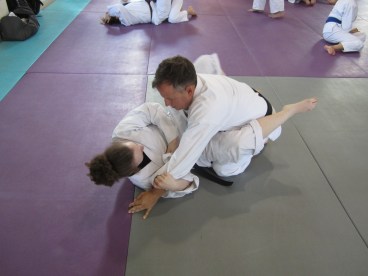
Hip Swivel

Throughout the seminar, Sensei Paul not only demonstrated his understanding of the body mechanics of ground techniques, but also demonstrated his ability as a teacher and coach. Sensei Paul taught individuals of varying backgrounds, such as BJJ, wrestling and karate. He explained techniques in a way that could be understood by individuals of any martial arts background. He is both patient and intellectual in his approach to teaching a group or an individual.

I feel we benefitted the most from Sensei Paul’s instruction in two ways. The first was through rolling. At the end of the seminar, we were given the opportunity to experiment with the variety of techniques we learned via two-minute grappling sessions. While rolling, we were told to go at different intensity levels, for example 60 percent, so everyone could practice in a safe and fun manner.

IMG_1466

The other opportunity we were given to gain knowledge was to ask questions. In Sensei Paul’s seminars, he gives everyone the opportunity to ask him about their experiences, what worked for them or didn’t work for them in the past as well as in the rolling session. In this way, Sensei Paul can tweak the techniques to fit the individual style, strengths and size of the student.

Although most karate practitioners do not pursue ground techniques, their standing technical knowledge operates on the same body mechanics as ground techniques.

You can observe the connective thread between standing and ground techniques through:

  • Kokutsu dachi and knee on belly position
  • Knee strike in comparison to both shiko-walk and “knee in guard” position
  • Hip rotation while doing a hip escape from the mount or transitioning to an arm bar from the guard

The body, of course, can only move in so many ways. We should expect that how we generate power standing can be applied the same way on the ground. Yet many karate practitioners continue to turn a blind eye to the importance of ground work and grappling,  even when common sense dictates that the principles of physics and body mechanics are applicable no matter what position someone is in.

The concepts found in our standing repertoire cannot be completely understood unless we recall karate’s true purpose: self-defence. To claim the art as self-defence and not address all the Habitual Acts of Physical Violence causes many to get stuck in one corner of their web. True martial artists must explore the concepts found in their systems with a critical gaze to see how the threads of their own practices connect with all other styles.

Looking for more striking inspiration? Follow The Martial Arts Muse on Facebook or Subscribe!
The Martial Arts Muse Tatami Promo

Old Woman Cries In Her Sleeve

I once heard a former student say, “I’ve paid hundreds of dollars on Karate. Spent hours of my time practicing. Working through injuries . . . and, for WHAT!?”

The only answer I could come up with is. . . something you should love.

I don’t know about anyone else, but over the short 14 years I’ve been pursuing the martial arts, my expenditure is probably in the hundred of thousands. I’ve spent hundreds of hours practicing, even through multiple injuries for no other reason than I love doing it.

So, when it came to me going to my final destination to train with Sensei McCarthy on his 2015 tour, although I felt like an old woman, there was no crying in my sleeve.

Virginia, October 9th-12th, 2015

At this event in Ashburn, Virginia, hosted by Sensei Darrin Johnson at Ashburn Martial Arts, Sensei McCarthy focused on Hakutsuru Tsuki-naka Ken [aka Chuan Xin Zhong Quan/白鹤穿心中拳 in Chinese].

Tsuki-Naka Ken

Tsuki-naka is the hardest kata I’ve had to learn—not because of its length or because the techniques in it are especially difficult; there are other kata that are far more difficult in those respects (Hakutsuru and Kusanku come to mind).

I believe the reason I found Tsuki-Naka challenging was for no other reason than mental and physical fatigue.

While learning this Yong-Chun based kata I overcame the challenges that accompany excessive travel and training in three ways:

1) Details

2) Zanshin

3) Teaching

Details

When you feel walls of exhaustion hit you, when your body hurts and your mind feels like it will burst with knowledge, concentrate on the details of your technique.

In Tsuki-naka, the movements have elements of dynamic tension and breathing, like those found commonly in Goju Ryu kata, combined with elegant and flowing movements of Chuan Fa.

Sensei McCarthy Applies Eagle Seizes His Prey

It was by focusing on getting these aspects of the kata just right, as well as its footwork, that helped me to keep going even if I wasn’t at my best.

Some may recognize this as an example of meditative state of isshin, single point concentration. For those unfamiliar with this term, isshin is to encompass all of one’s being into a single moment and once that moment has passed to release it.

In other words, the salvation from my practice was more mentally intense practice.

Zanshin

As is commonly expected with Sensei McCarthy’s Koryu Uchinadi seminars, there were a lot of two-person drills and kata applications. This held true with our in-depth analysis of applications for Tsuki-naka.

One movement in the kata includes crossing your arms like a genie and pulling your arms in opposite directions, a solo representation of one of the chokes straight out of our Shime-waza exercise: the rear-naked choke.

Mark Donohoe Applies Choke

Another application for a gyaku-zenkutsu dachi with a gedan barai and uchi uke, was a simple standing arm bar.

Sensei Nick in Gyaku Zenkutsu Dachi

Zanshin or general awareness was key for success in working with partners while in Virginia. Working through my injuries, it was important to pay close attention to how my body was feeling and adapt my training to ensure that I could still have a great learning experience and stay safe.

Communicating with the partners I worked with was a huge factor as well. One of the best things about walking into a Koryu Uchinadi Seminar is every one is really nice and willing to adjust so that each participant can have a positive training experience.

Teaching

Another way of overcoming my injuries in a seminar setting was taking the time to help others.

Once I had a good understanding of the techniques being taught, such as the takedowns, locks and chokes Sensei demonstrated, I took the time to assist participants who might need help learning many of the new techniques Sensei McCarthy introduced.

Sensei McCarthy Applies Ankle Lock

By doing this, I didn’t have to repeat the techniques as often, reducing my chances of aggravating my injury. At the same time, this helped me to gain a better conceptual understanding of the exercise at hand.

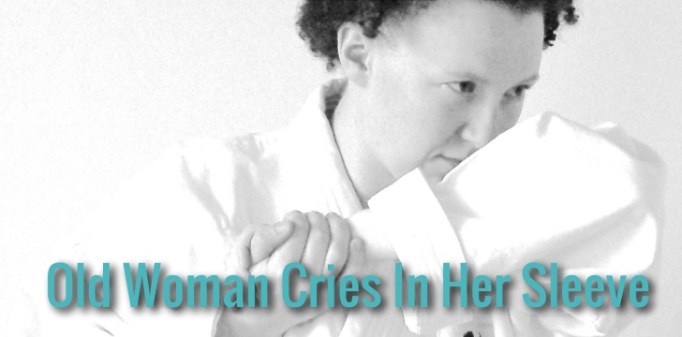
Old Woman Cries In Her Sleeve

There is a movement in many Koryu Uchinadi drills and Kata that we call old woman cries in her sleeve.

As I mentioned earlier, with my accumulated injuries and mental exhaustion, I very much felt like an old woman. And although there were no tears shed, I do feel sorrowful that my journey training with Sensei McCarthy was coming to an end.

There are so many other elements of going to seminars than just learning karate.

Camaraderie, travelling to new places, and meeting new people that you would otherwise never meet are just a few other reasons to take the time to go to seminars, not just offered by Koryu Uchinadi, but by any martial arts style.

For me, I go for the Karate, but stay for the wonderful people I meet.

KU Seminar Ashburn Virginia


February’s Video of the Month: Chris Prickett

If you’re looking for a real slick take down, check out this video from former Canadian Wrestling Champion, Chris Prickett.

In this tutorial Chris demonstrates one option from the underhook in the event the opponent starts to back away.

Moving on from this position you can simply climb up the body to mount if they turn to face you. Among other options, you can also take the back for Hadaka Jime (rear-naked choke).

Another reason I love this video is because it’s a great application for the Koryu Uchinadi ground kicking drill, Ne-Keri Waza.

Chris Prickett’s simple and elegant execution of this unique technique is what makes his demonstration The Martial Arts Muse’s Video of the Month!

Check out more of Chris Prickett’s videos and the best of Canadian wrestling on his YouTube Channel, 49 North Wrestling.

Review: Project 16 Hand Positioning

“Do not seek to follow in the footsteps of the wise. Seek what they sought.” – Matsuo Basho

It is these words of Matsuo Basho that come to mind after watching Koryu Uchinadi Kyoshi Ante Brännbacka’s first video on hand positioning from his Project 16 series.

The Matrix of Karate

Using the Koryu Uchinadi mindset of classical tradition with contemporary insight, as well as the Japanese maxim of 精力善用 (“Seiryoku Zenyou” – maximum efficiency with minimum effort), Kyoshi Brännbacka’s instructional video breaks down positioning in a self-defense situation while categorizing your options to defend and counter single hand attacks.

Kyoshi Brännbacka takes you through the learning process by demonstrating each position. The number sixteen of Project 16 represents the different hand positions you can have. You can be on the inside or outside of the attacker’s hands. The attacks can be to the upper and lower level while you use either left or right hand to defend.

From here, he provides added counters creating a simple, efficient and effective standing flow drill to help learners recognize and retain defenses against strikes to the body.

But the fun doesn’t stop there!
The video goes on to demonstrate exits to escape the flow drill with an emphasis on practicality while utilizing leg strikes and takedowns.

Be sure to pay attention to Sensei Ante’s tips to make each technique more effective.

He then takes the drill to another level by integrating the set ups of the takedowns into the original flow drill. This can aid in the memorization of the corresponding exit to each hand position without having to repeatedly take your partner down. At the same time, it increases repetition and helps students learn to switch from one technique to the next—an important skill to have in the event things don’t go as planned.

Review Project 16 Hand Positioning

Kyoshi Brännbacka emphasizes the importance of stepping outside the drill by using the exits as taught in the video, but also encourages adding your own flare by integrating other techniques you have learned elsewhere and slowly adding aggressive resistance to reach the ultimate goal of functional spontaneity.

In the final stages of the video, Kyoshi Brännbacka demonstrates the corresponding solo exercise (the kata). The kata is a simple way to practice the drill in the event you don’t have another person to work with. Kyoshi maintains one shouldn’t just practice the drill aimlessly. In order to gain the benefits of the solo exercise you need to visualize the application you are practicing. He adds that kata is a great opportunity to perfect body mechanics and alignment and should be a representation of a perfectly executed plan.

His systematic analysis of positioning provides a fresh look at how to address strikes in a hand-to-hand combat scenario. If you’re looking for a new way to analyze self-defense situations, this is the video for you!
Be sure to watch out for Kyoshi Ante Brännbacka’s other videos for more great content!

But, don’t take my word for it.

See Kyoshi Ante Brännbacka in action now!