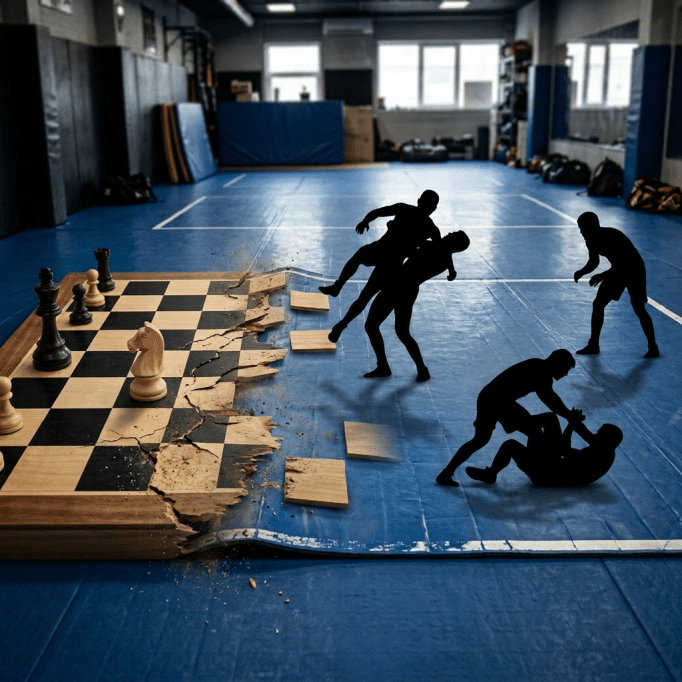
Chess board breaking and transitioning into grappling mat with black silhouettes of wrestlers grappling

Eco-BJJ Explained: Benefits and Limitations of the Approach

There’s always a new martial arts trend rolling onto the mats like it invented jiu-jitsu last Tuesday. Usually, it comes with a few buzzwords, a few takedowns on “outdated” training, and a strong whiff of condescension for anyone who doesn’t immediately bow to its superiority.

Enter Eco-BJJ, also known as the ecological or constraint-led approach. If you’ve ever heard someone say “we don’t teach techniques here, we build natural grapplers,” congrats—you’ve met the movement.

Now, if you’re picturing students running around like kids on a playground while the coach mumbles something about “task-based learning,” you’re not entirely wrong.

But you’re also missing the point.

Let’s break it down.


🌱 What Even Is Eco-BJJ?

At its core, Eco-BJJ is the art of designing environments rather than dictating steps.

Instead of drilling armbar setups from closed guard for twenty minutes, your coach might just say: “Top player, pass the guard. Bottom player, sweep or submit. Go.”

That’s it. No technical walkthrough. No lecture. Just chaos.

Glorious, sweaty chaos!

This style of training emphasizes problem-solving through movement. You’re not memorizing—you’re discovering. Like a toddler learning to walk… if that toddler were being leg-locked by a purple belt.

The goal is to create grapplers who don’t just know techniques—they feel them. Under pressure. With resistance. Without needing to be spoon-fed every step.


🧠 Grappling Without the Flashcards

One of the biggest perks? Eco-BJJ builds intuitive fighters.

These are the students who couldn’t name a single guard variation if their life depended on it, but can shut down your game mid-roll like they downloaded it in real time.
They may not know the terminology. But they’ve lived the movement over and over again in real, messy scenarios. That kind of fluency can’t be faked.

It’s the difference between memorizing a speech and knowing how to talk your way out of a bar fight.

And honestly, some people light up in this setting. Athletes. Kinesthetic learners. Folks with short attention spans and fast reaction times. It can feel like coming home.

But—cue the record scratch—it doesn’t work for everyone.


🥵 The Dark Side of “Just Figure It Out”

If you’re not naturally athletic… if movement doesn’t come easy to you… if you like learning with a bit of structure—this method can feel like being thrown into the ocean with the instructions, “Just feel the water.”
Spoiler: not everyone floats.

Eco-BJJ tends to reward the naturally gifted—the wrestlers, the gymnasts, the folks whose spatial awareness is dialled in. But students who need clarity, repetition, and verbal guidance? They can feel overwhelmed or even left behind.

Which brings us to a less-sexy truth…


👎 Intuition ≠ Instruction

One of the under-discussed downsides of Eco-BJJ is that it doesn’t always produce good teachers.

Just because someone can do something instinctively doesn’t mean they can explain why it works—or how to help someone else get there.

When your understanding is rooted in feel rather than formal knowledge, it can be hard to reverse-engineer your success for someone who doesn’t move like you.

It’s the same reason great athletes don’t always make great coaches. They knew the answer with their bodies, but they never had to put it into words.
If we’re trying to build a generation of confident instructors—not just clever grapplers—there still has to be room for explicit teaching, structured learning, and yes… actual technique.


🤷‍♀️ Is Eco-BJJ New? Or Just Good Coaching With a Trendy Name?

Here’s the kicker: many of the best coaches have been using ecological methods for years… they just didn’t need to rebrand it.

Any time you’ve done situational sparring, grip fighting with limited tools, or positional games, you were already dabbling in constraint-led training.

What’s different now is the packaging, the jargon, and sometimes the cult-like belief that this is the One True Way.
Newsflash: it’s not.

And that’s okay.

Like anything else in martial arts, Eco-BJJ is a tool. Powerful? Absolutely. All-encompassing? Not even close.


🧩 So Who’s It For?

Eco-BJJ is brilliant for developing timing, creativity, and adaptability under stress. It’s messy, organic, and honest.

But it’s not a one-size-fits-all solution. Beginners need structure. Some people need repetition. And not every coach is equipped to design learning games that lead somewhere productive.

Use it. Blend it. But don’t worship it.

Because at the end of the day, the job isn’t to teach students to win games—it’s to help them understand why they won.


💬 Final Thoughts from the Muse

Eco-BJJ is a refreshing shift away from cookie-cutter techniques and endless drilling. It teaches grapplers to think, adapt, and move intuitively—which is a massive gift in a live roll.

But like any shiny new methodology, it comes with blind spots.

It can leave less athletic students behind. It can build athletes who can’t teach. And it can make you think you’ve discovered something revolutionary when really… You just renamed sparring.

If you’re a coach, use ecological games. But also teach techniques. Help your students name what they’re doing and why it works. Build movers, yes—but also build thinkers, communicators, and future instructors.

Because intuition might win rounds and build athletes…
But insight? That builds life, long martial artists.


Want more breakdowns of martial arts trends with a healthy dose of realism (and sarcasm)? Stick with The Martial Arts Muse for takes that are equal parts practical and painfully honest.

“Just Bridge” – A Females Perspective on Grappling

“Just bridge…”

“Just push them over…”

This might just be me, but the word “just” might be the most condescending word in the English language.

The word “just” sometimes implies a sense of simplicity or insignificance, which can inadvertently belittle the complexity of a situation or someone’s efforts. For instance, phrases like “It’s just a minor issue” might downplay someone’s concerns or experiences.

Its undertones can create an air of superiority or impatience, subtly diminishing the importance of the matter at hand. To foster respectful and inclusive communication, it’s important to be mindful of the potential condescending undertones associated with the word – in this instance, in the context of martial arts classes.

If accomplishing something were truly as easy as “just” doing it, there would be no need for consistent practice and dedication.

In my 25+ years of experience in martial arts, I’ve found it common for some instructors to underestimate the differences in strength, speed, power, and leverage between their male and female students. I’ve seen this even more so with men I’ve rolled and sparred with.

Some such differences can include strength, bone density, fast-twitch muscle groups, and reach, which can sometimes make it much more difficult for a female to perform as well against their male counterparts.

But this isn’t the only dichotomy; this can also be seen with taller instructors/ sparring partners underestimating the issues faced by shorter students and vice versa, or younger instructors/sparring partners with older students, etc.

When the instructor tells the group to roll or spar at “50%” (which often very few people do, except for those with experience), it’s important to remember that one person’s 50% effort can be another person’s 120% effort. Hence, the younger, stronger, or more experienced grapplers or strikers must remember to curb their efforts towards the capacity of their older, weaker, or less experienced partners.

This act of equity can ensure that both parties can enjoy the practice while still learning. Nobody enjoys the feeling of being completely crushed by their partner in practice, particularly when they are truly putting their best efforts forward – it’s defeating.

Hence, in such scenarios, when the partner or instructor asks, “Why didn’t you just armbar me?” or says, “You know you could have just bridged and rolled there…” They’re actually rubbing salt in an open wound. If knowing the correct technique was all that was needed to be competitive in martial arts as a sport, we wouldn’t have weight classes, and steroids wouldn’t be so frowned upon.

But whether you practice martial arts for sport and fitness or for self-defence, knowing how to adjust your energies for the benefit of your partners and how to communicate with them effectively, as well as how to communicate to others how to do so for the sake of your students if you’re instructors, can make the difference between a growing community within your club and disgruntled ex-students.

So, let’s retire the word “just” from our martial arts vocabulary—at least when it’s used to trivialize challenges or dismiss effort. Progress in martial arts, like in life, is rarely simple, and implying otherwise undermines the grit, growth, and respect that define the journey. Whether you’re sparring with a partner, teaching a class, or simply offering advice, choose words that build bridges, not barriers.

Because in the end, martial arts isn’t about “just” winning—it’s about lifting each other up, one roll, one spar, and one carefully chosen word at a time.

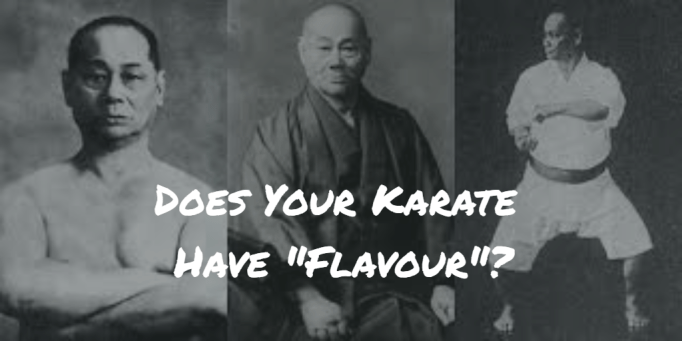
Does Your Karate Have “Flavour”?

“It is necessary to drink alcohol and pursue other fun activities. The art [karate] of someone who is too serious has no flavour.” – Motobu Choki

I have a karate friend, sharing the sentiments of Motobu, who said, “if you can’t do a kata drunk, you can’t do it at all!”

I know of many BJJ practitioners who choose to smoke weed before training. Even while attending BJJ tournaments here in Canada, where marijuana is legal, I’ve seen dozens of practitioners smoke a joint before their matches. In the hopes to, as Eddie Bravo as said, “rely more on your instincts,” and let “your body take over. . . you don’t think about it, you just do it.”

Although I’ve never been high while training, I have taken CBD before practice and can speak to its benefits. I was far more relaxed both mentally and physically. When hitting mitts, I didn’t get gassed out as quickly, and my technique was far more on point. While grappling, I didn’t feel as anxious while being smothered in bottom positions, which allowed me to see more openings for escapes and various submissions. I also cared less about making mistakes; I took more risks that I might otherwise be afraid to take. Because of this, I found the experience generally more enjoyable. I embraced the experience of training.

One doesn’t need to do drugs or alcohol to gain these benefits. Simply, one can embrace child-like playfulness. Hence, so many speak of the importance of the beginner’s mind, shoshin, a concept from Zen Buddhism, for which I find many advocate but rarely actually practice.

I’m not necessarily trying to support alcohol or drug use in training, but there’s something to be said about the quality of someone’s practice and their relaxed nature towards their martial arts.

Rigidity does not breed creativity.

In the video below, Firas Zahabi speaks to the importance of this.

He uses Muay Thai and Russian wrestlers as an example. The Russians don’t go full out every practice; they have a type of focused play. Because they’re not too serious when practicing, their training is more explorative and allows for more consistent, quality reps.

Regarding Muay Thai practitioners, who have also been known to smoke and drink before their matches, Firas speaks about when they train with someone too serious or aggressive; they’ll view the individual as “too amateur.”

In an episode of the Ultimate Fighter, George St. Pierre introduced a French Muay Thai fighter who would get drunk before training and referred to him as a “free-thinker.”

GSP has also been known to have a glass of wine during his training camps. One of my favourite pass times on a sunny weekend afternoon is to enjoy a glass of wine while going through kata, or practicing weaponry. Not unlike having a beer at the golf course, it makes the practice more enjoyable and makes it an act of unwinding.

The underlying principle of using alcohol or drugs to facilitate practice, I think, is to allow for a flow state, which, as Firas Zahabi points out, is key to consistent and enjoyable training. So when Motobu speaks of flavour, perhaps he means that someone who is too serious has no flowwhich I think most can agree, is essential for creativity and functional spontaneity. 

Regardless of whether you choose to use alcohol or drugs or reap the benefits of integrating it into training, practicing martial arts should always be fun. Instructors who take themselves and their art too seriously tend to be less than enjoyable to train with, can be insufferably traditional and a complete bore. Do you think Motobu’s quote was directed at Funakoshi?

Martial arts like a fine wine, you don’t drink it with the purpose of finishing the glass, but to enjoy every sip. If you’re not enjoying the journey, why continue on the path?

Cheers!

Enjoyed this blog? Check out Karate and The Sunk Cost Fallacy!