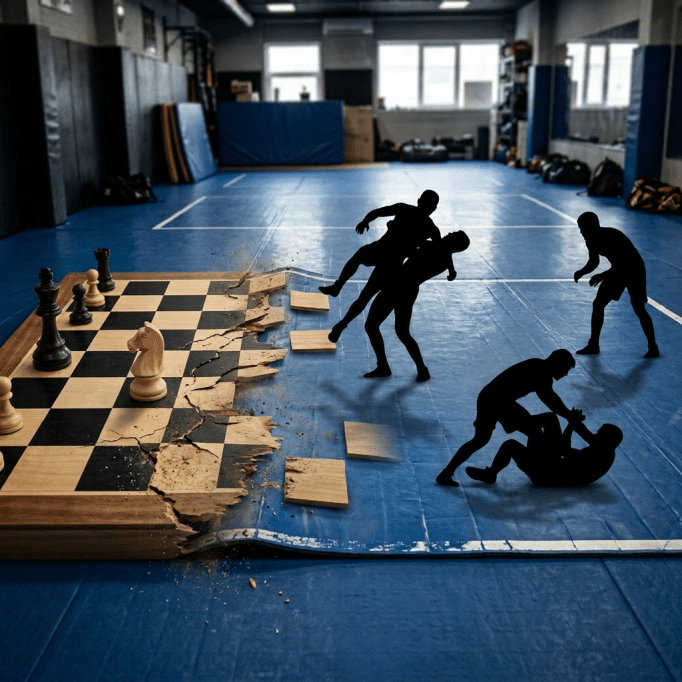
Chess board breaking and transitioning into grappling mat with black silhouettes of wrestlers grappling

Eco-BJJ Explained: Benefits and Limitations of the Approach

There’s always a new martial arts trend rolling onto the mats like it invented jiu-jitsu last Tuesday. Usually, it comes with a few buzzwords, a few takedowns on “outdated” training, and a strong whiff of condescension for anyone who doesn’t immediately bow to its superiority.

Enter Eco-BJJ, also known as the ecological or constraint-led approach. If you’ve ever heard someone say “we don’t teach techniques here, we build natural grapplers,” congrats—you’ve met the movement.

Now, if you’re picturing students running around like kids on a playground while the coach mumbles something about “task-based learning,” you’re not entirely wrong.

But you’re also missing the point.

Let’s break it down.


🌱 What Even Is Eco-BJJ?

At its core, Eco-BJJ is the art of designing environments rather than dictating steps.

Instead of drilling armbar setups from closed guard for twenty minutes, your coach might just say: “Top player, pass the guard. Bottom player, sweep or submit. Go.”

That’s it. No technical walkthrough. No lecture. Just chaos.

Glorious, sweaty chaos!

This style of training emphasizes problem-solving through movement. You’re not memorizing—you’re discovering. Like a toddler learning to walk… if that toddler were being leg-locked by a purple belt.

The goal is to create grapplers who don’t just know techniques—they feel them. Under pressure. With resistance. Without needing to be spoon-fed every step.


🧠 Grappling Without the Flashcards

One of the biggest perks? Eco-BJJ builds intuitive fighters.

These are the students who couldn’t name a single guard variation if their life depended on it, but can shut down your game mid-roll like they downloaded it in real time.

They may not know the terminology. But they’ve lived the movement over and over again in real, messy scenarios. That kind of fluency can’t be faked.

It’s the difference between memorizing a speech and knowing how to talk your way out of a bar fight.

And honestly, some people light up in this setting. Athletes. Kinesthetic learners. Folks with short attention spans and fast reaction times. It can feel like coming home.

But—cue the record scratch—it doesn’t work for everyone.


🥵 The Dark Side of “Just Figure It Out”

If you’re not naturally athletic… if movement doesn’t come easy to you… if you like learning with a bit of structure—this method can feel like being thrown into the ocean with the instructions, “Just feel the water.”

Spoiler: not everyone floats.

Eco-BJJ tends to reward the naturally gifted—the wrestlers, the gymnasts, the folks whose spatial awareness is dialled in. But students who need clarity, repetition, and verbal guidance? They can feel overwhelmed or even left behind.

Which brings us to a less-sexy truth…


👎 Intuition ≠ Instruction

One of the under-discussed downsides of Eco-BJJ is that it doesn’t always produce good teachers.

Just because someone can do something instinctively doesn’t mean they can explain why it works—or how to help someone else get there.

When your understanding is rooted in feel rather than formal knowledge, it can be hard to reverse-engineer your success for someone who doesn’t move like you.

It’s the same reason great athletes don’t always make great coaches. They knew the answer with their bodies, but they never had to put it into words.
If we’re trying to build a generation of confident instructors—not just clever grapplers—there still has to be room for explicit teaching, structured learning, and yes… actual technique.


🤷‍♀️ Is Eco-BJJ New? Or Just Good Coaching With a Trendy Name?

Here’s the kicker: many of the best coaches have been using ecological methods for years… they just didn’t need to rebrand it.

Any time you’ve done situational sparring, grip fighting with limited tools, or positional games, you were already dabbling in constraint-led training.

What’s different now is the packaging, the jargon, and sometimes the cult-like belief that this is the One True Way.
Newsflash: it’s not.

And that’s okay.

Like anything else in martial arts, Eco-BJJ is a tool. Powerful? Absolutely. All-encompassing? Not even close.


🧩 So Who’s It For?

Eco-BJJ is brilliant for developing timing, creativity, and adaptability under stress. It’s messy, organic, and honest.

But it’s not a one-size-fits-all solution. Beginners need structure. Some people need repetition. And not every coach is equipped to design learning games that lead somewhere productive.

Use it. Blend it. But don’t worship it.

Because at the end of the day, the job isn’t to teach students to win games—it’s to help them understand why they won.


💬 Final Thoughts from the Muse

Eco-BJJ is a refreshing shift away from cookie-cutter techniques and endless drilling. It teaches grapplers to think, adapt, and move intuitively—which is a massive gift in a live roll.

But like any shiny new methodology, it comes with blind spots.

It can leave less athletic students behind. It can build athletes who can’t teach. And it can make you think you’ve discovered something revolutionary when really… You just renamed sparring.

If you’re a coach, use ecological games. But also teach techniques. Help your students name what they’re doing and why it works. Build movers, yes—but also build thinkers, communicators, and future instructors.

Because intuition might win rounds and build athletes…
But insight? That builds life, long martial artists.


Want more breakdowns of martial arts trends with a healthy dose of realism (and sarcasm)? Stick with The Martial Arts Muse for takes that are equal parts practical and painfully honest.
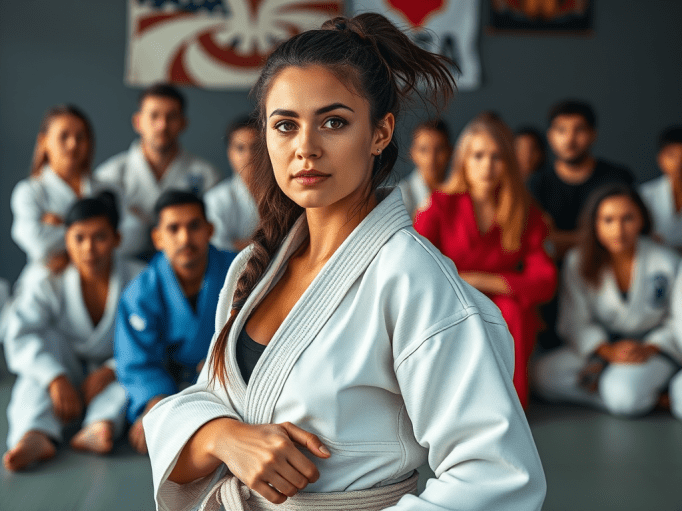

Why Women Quit Brazilian Jiu-Jitsu (and All Martial Arts, Really): The Real Deal (And How We Can Fix It)

So you’ve seen more women hitting the mats lately — awesome! But you’ve probably also noticed that a lot of them don’t stick around. Why do women quit BJJ, a sport that’s supposed to be about empowerment, grit, and, well, chokeholds?

Spoiler alert: it’s not just BJJ. These challenges play out across all martial arts.

Turns out, quitting isn’t always about toughness or lack of willpower. It’s more about the environment, the culture, and yes, sometimes just how physically and psychologically demanding the sport really is. Here’s what I found, after digging into Reddit threads, surveys, and some real talk from the mats.


It’s Not “Just” Injuries or Time — But They Matter

Let’s start with the obvious. Injuries suck. Martial arts are not a Sunday stroll — they’re physical grinds, and injuries pile up like laundry after a week-long training binge. One Reddit user summed it up nicely:

“I loved training, but after several nagging injuries and a hectic work schedule, I just couldn’t keep up.”

Busy schedules and life changes—kids, jobs, and the dreaded “adult stuff”—also pull people off the mats. Women often juggle more of these responsibilities, which can mean less time and energy for training.

But injuries and time, while universal hurdles, are just the start for women.


When the Gym Culture Feels Like a Contact Sport of Its Own

This is where it gets tricky. Women report facing microaggressions, awkward (or worse) advances, and a culture that sometimes feels less like a supportive dojo and more like a boys’ club with grappling.

A user on Reddit’s r/xxfitness nailed it:

“Sometimes you feel like you’re not there to learn but to be the token girl or worse, to entertain some guys’ egos.”

Training shouldn’t feel like an audition for a reality show titled “How Much Can She Take?” But sadly, many women experience exactly that.


The Isolation Factor: When You’re the Only Woman on the Mat

Nothing like being the lone woman surrounded by twenty dudes who think “tap” is just a style of dance. It can feel like every mistake is magnified, like you’re carrying the weight of representing all women in martial arts.

One purple belt shared on a forum:

“It can feel like you’re representing all women, so every mistake or failure feels magnified.”

Isolation breeds self-doubt, and self-doubt leads to walking away.


Partnering Mismatches: When Training Partners Are More Like Giants

Martial arts training is intimate — you’re literally rolling around, tangled up with strangers. If you’re a 135-pound woman paired with a 300-pound man who looks like he bench-presses cars, it’s less “challenge” and more “survival mode.”

This can make training feel unsafe or discouraging rather than empowering. It’s not just about strength — mismatched partners can knock confidence down like a row of dominoes.


What the Numbers Say (Even If We Don’t Have All the Answers)

Women are estimated to make up about 20% of BJJ practitioners, but fewer than 1 in 10 are coaches — and even fewer are black belt head instructors. That’s a glaring gender gap — and representation matters.

A survey from the Women in Sport Institute highlighted how body image and puberty-related issues cause many girls and women to drop out of sports early — and those factors echo in martial arts dropout rates too.

There aren’t many hard stats on why women quit BJJ specifically, but anecdotal evidence, surveys, and forum chatter tell a consistent story: injuries, time constraints, toxic culture, and lack of support top the list.


This Isn’t Just BJJ — It’s a Martial Arts-Wide Challenge

While I’m focusing on Brazilian Jiu-Jitsu, since it is the main martial art I practice now, the reality is these issues affect women across all martial arts — whether it’s karate, taekwondo, judo, muay thai, or any other style. The combination of physical injuries, male-dominated training spaces, and cultural barriers is a common thread that can drive women away.

The good news is that the solutions are similar across disciplines: fostering respect, creating safe and inclusive spaces, offering women-specific programs, and mentoring. When martial arts gyms commit to these changes, everyone benefits.


How Gyms Can Step Up and Keep Women on the Mats

The good news? This isn’t a lost cause. Gyms can do a lot to make martial arts more welcoming for women — and everyone benefits.

  • Create an inclusive culture. Call out bad behavior, foster respect, and make it clear harassment won’t be tolerated.
  • Offer women-only classes or open discussions. Safe spaces build confidence and community.
  • Mentorship programs. Pair new female practitioners with experienced women to guide and encourage them.
  • Be mindful about training partners. Avoid pairing women with partners so mismatched that they’re scared before the first grip.

Final Thoughts

Women don’t quit martial arts because they’re not tough enough. They quit because the sport sometimes asks more than it gives back — especially in environments that don’t acknowledge their specific challenges.

If we want more women sticking around and thriving on the mats, it’s on us — instructors, gym owners, and teammates — to listen, adapt, and create spaces where everyone feels respected and empowered.

Every roll should build trust, every tap should build respect. If women leave because we failed at both, then maybe the real fight was never on the mats — but in how we treat each other off them.


Having posted previously about women’s issues in the martial arts, I know I will receive some provincial, small-minded and hateful comments, and to that I say: “You don’t win friends with salad!”

If you’re a woman who’s trained martial arts, or a coach wanting to improve gym culture, I’d love to hear your thoughts. Drop a comment or reach out — this conversation matters.