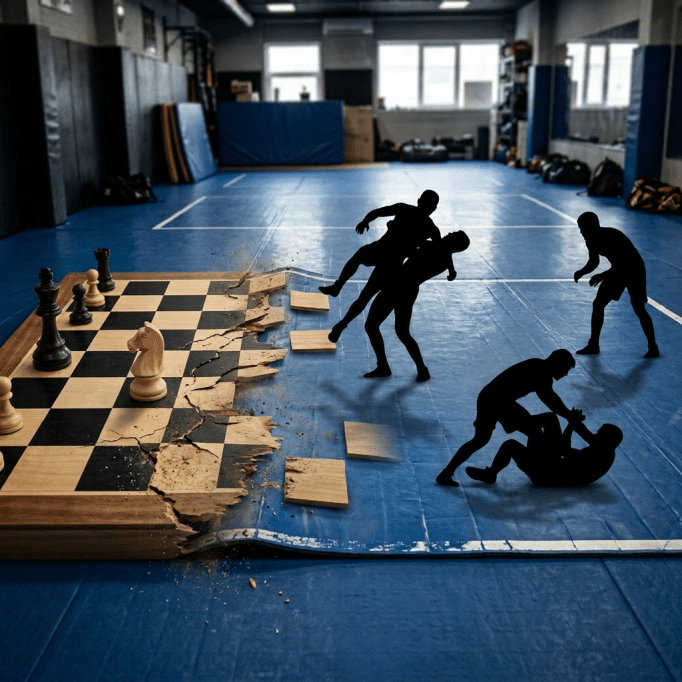
There’s always a new martial arts trend rolling onto the mats like it invented jiu-jitsu last Tuesday. Usually, it comes with a few buzzwords, a few takedowns on “outdated” training, and a strong whiff of condescension for anyone who doesn’t immediately bow to its superiority.
Enter Eco-BJJ, also known as the ecological or constraint-led approach. If you’ve ever heard someone say “we don’t teach techniques here, we build natural grapplers,” congrats—you’ve met the movement.
Now, if you’re picturing students running around like kids on a playground while the coach mumbles something about “task-based learning,” you’re not entirely wrong.
But you’re also missing the point.
Let’s break it down.
🌱 What Even Is Eco-BJJ?
At its core, Eco-BJJ is the art of designing environments rather than dictating steps.
Instead of drilling armbar setups from closed guard for twenty minutes, your coach might just say: “Top player, pass the guard. Bottom player, sweep or submit. Go.”
That’s it. No technical walkthrough. No lecture. Just chaos.
Glorious, sweaty chaos!

This style of training emphasizes problem-solving through movement. You’re not memorizing—you’re discovering. Like a toddler learning to walk… if that toddler were being leg-locked by a purple belt.
The goal is to create grapplers who don’t just know techniques—they feel them. Under pressure. With resistance. Without needing to be spoon-fed every step.
🧠 Grappling Without the Flashcards
One of the biggest perks? Eco-BJJ builds intuitive fighters.
These are the students who couldn’t name a single guard variation if their life depended on it, but can shut down your game mid-roll like they downloaded it in real time.

They may not know the terminology. But they’ve lived the movement over and over again in real, messy scenarios. That kind of fluency can’t be faked.
It’s the difference between memorizing a speech and knowing how to talk your way out of a bar fight.
And honestly, some people light up in this setting. Athletes. Kinesthetic learners. Folks with short attention spans and fast reaction times. It can feel like coming home.
But—cue the record scratch—it doesn’t work for everyone.
🥵 The Dark Side of “Just Figure It Out”
If you’re not naturally athletic… if movement doesn’t come easy to you… if you like learning with a bit of structure—this method can feel like being thrown into the ocean with the instructions, “Just feel the water.”

Spoiler: not everyone floats.
Eco-BJJ tends to reward the naturally gifted—the wrestlers, the gymnasts, the folks whose spatial awareness is dialled in. But students who need clarity, repetition, and verbal guidance? They can feel overwhelmed or even left behind.
Which brings us to a less-sexy truth…
👎 Intuition ≠ Instruction
One of the under-discussed downsides of Eco-BJJ is that it doesn’t always produce good teachers.
Just because someone can do something instinctively doesn’t mean they can explain why it works—or how to help someone else get there.
When your understanding is rooted in feel rather than formal knowledge, it can be hard to reverse-engineer your success for someone who doesn’t move like you.
It’s the same reason great athletes don’t always make great coaches. They knew the answer with their bodies, but they never had to put it into words.

If we’re trying to build a generation of confident instructors—not just clever grapplers—there still has to be room for explicit teaching, structured learning, and yes… actual technique.
🤷♀️ Is Eco-BJJ New? Or Just Good Coaching With a Trendy Name?
Here’s the kicker: many of the best coaches have been using ecological methods for years… they just didn’t need to rebrand it.
Any time you’ve done situational sparring, grip fighting with limited tools, or positional games, you were already dabbling in constraint-led training.
What’s different now is the packaging, the jargon, and sometimes the cult-like belief that this is the One True Way.
Newsflash: it’s not.
And that’s okay.
Like anything else in martial arts, Eco-BJJ is a tool. Powerful? Absolutely. All-encompassing? Not even close.
🧩 So Who’s It For?
Eco-BJJ is brilliant for developing timing, creativity, and adaptability under stress. It’s messy, organic, and honest.
But it’s not a one-size-fits-all solution. Beginners need structure. Some people need repetition. And not every coach is equipped to design learning games that lead somewhere productive.
Use it. Blend it. But don’t worship it.

Because at the end of the day, the job isn’t to teach students to win games—it’s to help them understand why they won.
💬 Final Thoughts from the Muse
Eco-BJJ is a refreshing shift away from cookie-cutter techniques and endless drilling. It teaches grapplers to think, adapt, and move intuitively—which is a massive gift in a live roll.
But like any shiny new methodology, it comes with blind spots.
It can leave less athletic students behind. It can build athletes who can’t teach. And it can make you think you’ve discovered something revolutionary when really… You just renamed sparring.
If you’re a coach, use ecological games. But also teach techniques. Help your students name what they’re doing and why it works. Build movers, yes—but also build thinkers, communicators, and future instructors.
Because intuition might win rounds and build athletes…
But insight? That builds life, long martial artists.
Want more breakdowns of martial arts trends with a healthy dose of realism (and sarcasm)? Stick with The Martial Arts Muse for takes that are equal parts practical and painfully honest.

