February’s Video of the Month: Chris Prickett

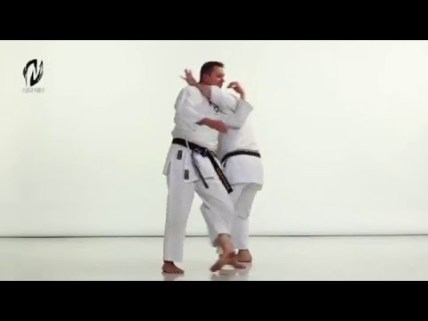
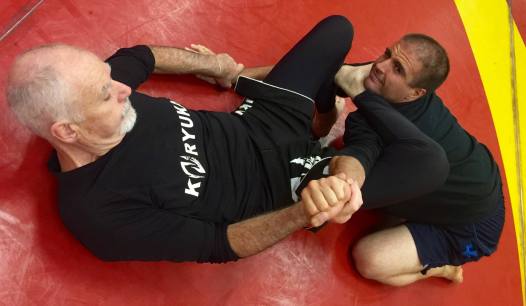
If you’re looking for a real slick take down, check out this video from former Canadian Wrestling Champion, Chris Prickett.

In this tutorial Chris demonstrates one option from the underhook in the event the opponent starts to back away.

Moving on from this position you can simply climb up the body to mount if they turn to face you. Among other options, you can also take the back for Hadaka Jime (rear-naked choke).

Another reason I love this video is because it’s a great application for the Koryu Uchinadi ground kicking drill, Ne-Keri Waza.

Chris Prickett’s simple and elegant execution of this unique technique is what makes his demonstration The Martial Arts Muse’s Video of the Month!

Check out more of Chris Prickett’s videos and the best of Canadian wrestling on his YouTube Channel, 49 North Wrestling.

Review: Project 16 Hand Positioning

“Do not seek to follow in the footsteps of the wise. Seek what they sought.” – Matsuo Basho

It is these words of Matsuo Basho that come to mind after watching Koryu Uchinadi Kyoshi Ante Brännbacka’s first video on hand positioning from his Project 16 series.

The Matrix of Karate

Using the Koryu Uchinadi mindset of classical tradition with contemporary insight, as well as the Japanese maxim of 精力善用 (“Seiryoku Zenyou” – maximum efficiency with minimum effort), Kyoshi Brännbacka’s instructional video breaks down positioning in a self-defense situation while categorizing your options to defend and counter single hand attacks.

Kyoshi Brännbacka takes you through the learning process by demonstrating each position. The number sixteen of Project 16 represents the different hand positions you can have. You can be on the inside or outside of the attacker’s hands. The attacks can be to the upper and lower level while you use either left or right hand to defend.

From here, he provides added counters creating a simple, efficient and effective standing flow drill to help learners recognize and retain defenses against strikes to the body.

But the fun doesn’t stop there!

The video goes on to demonstrate exits to escape the flow drill with an emphasis on practicality while utilizing leg strikes and takedowns.

Be sure to pay attention to Sensei Ante’s tips to make each technique more effective.

He then takes the drill to another level by integrating the set ups of the takedowns into the original flow drill. This can aid in the memorization of the corresponding exit to each hand position without having to repeatedly take your partner down. At the same time, it increases repetition and helps students learn to switch from one technique to the next—an important skill to have in the event things don’t go as planned.

Review Project 16 Hand Positioning

Kyoshi Brännbacka emphasizes the importance of stepping outside the drill by using the exits as taught in the video, but also encourages adding your own flare by integrating other techniques you have learned elsewhere and slowly adding aggressive resistance to reach the ultimate goal of functional spontaneity.

In the final stages of the video, Kyoshi Brännbacka demonstrates the corresponding solo exercise (the kata). The kata is a simple way to practice the drill in the event you don’t have another person to work with. Kyoshi maintains one shouldn’t just practice the drill aimlessly. In order to gain the benefits of the solo exercise you need to visualize the application you are practicing. He adds that kata is a great opportunity to perfect body mechanics and alignment and should be a representation of a perfectly executed plan.

His systematic analysis of positioning provides a fresh look at how to address strikes in a hand-to-hand combat scenario. If you’re looking for a new way to analyze self-defense situations, this is the video for you!

Be sure to watch out for Kyoshi Ante Brännbacka’s other videos for more great content!

But, don’t take my word for it.

See Kyoshi Ante Brännbacka in action now!

Lady Puts on a Necklace

North American Gasshuku, Georgetown, 2015

2015 Gasshuku Go KU

During the 2015 Gasshuku with Hanshi Patrick McCarthy, hosted by Sensei Tony Rampulla, our main focus was Riai Kumite, exploring combinations from the Aiki Kenpo Jujutsu syllabus and Niseishi Kata. We were also taught by guest instructors Sensei Scott Hogarth, Sensei Monty Guest, Sensei Cezar Borkowski and Sensei Ron Beer.

This year’s Gasshuku was by far the most unique with the vast scope of knowledge, experience and ideas on the martial arts taught by these highly regarded instructors. The topics ranged from Silat-based knife work, the simplicity of high block, the importance of distance and how to use personal anecdotes to teach your lesson.

With every Gasshuku, there is also a grading. Of those in attendance, many were promoted, including myself to Nidan.

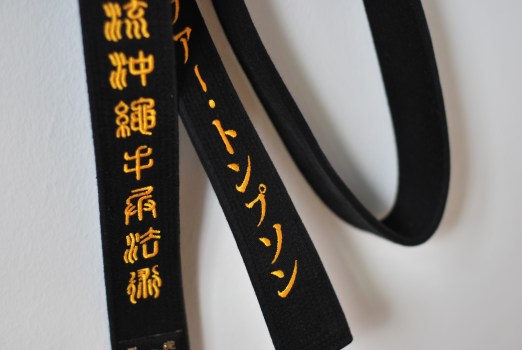
When we first wear a black belt, like putting on a pearl necklace, we question whether we are worthy of wearing something of such great value.

Since receiving my promotion, I’ve been absorbed with the question of “what does it really mean to be a black belt?”

DSC_0026

Does someone deserve a black belt out of loyalty? Should you be promoted just for skill? Is your belt equal to your attitude? Are you ranked on your ability to memorize all the drills?

I think we all have our own ideas. Promotions are based on a number of variables and the values of a specific club or style.

For me, the value of a black belt doesn’t lie in what we have done to receive it, but what we will do to represent our style, teacher and most importantly ourselves as entities that promote as Sokon ‘Bushi’ Matsumura says “virtue before vice, values before vanity and principles before personalities.”

If you have been in the martial arts long enough, you will see many who receive their black belt, then just quit.

There are some people who receive their black belt and feel like they are the new badass in town. Their egos inflate to the size of an elephant.

There are those who hold their knowledge close. With no interest in teaching, they flaunt their abilities in the faces of those around them. Perhaps they even surpass the skill of their teacher.

For these people, no one will ever follow them. They will have no legacy.

Since the beginning of my martial arts training, I’ve always had a stern and determined mindset.

Gasshuku 2015 Tegume

I don’t compete with others. I do the best that I can.

With this attitude I set very strict goals and take ownership of my learning process.

This is where I think many fail.

Up until your Shodan, you are told exactly what to learn, how to learn it and if you’re lucky, maybe you even learn how to teach it. Your teacher will have always been there to assist you. However, after that, it feels little like you are in Karate Limbo, waiting for someone to tell you what to do.

I believe a black belt should have enough agency to walk the path of Karate autonomously. By this I mean you should set a schedule for your own learning process. Learn the things you feel you need to work on. Search out teachers who can help you achieve this, as opposed to simply waiting for your Sensei to tell you what’s next.


In preparation for the 2015 Gasshuku, I put it upon myself to learn as many of the supplementary drills in Koryu Uchinadi as I could manage, which include, but are no limited to:

Learning all the drills wasn’t something I was told to do. It is something I expected of myself.

At the same time, through learning all the ways you can manipulate the body, it makes it exponentially easier to learn, practice and retain the combinations taught during the Gasshuku.

For example, Sensei McCarthy presented Aiki Kenpo Jujutsu combinations taught by Carlos “the Ronin” Newton from last year’s Gasshuku, as well as his own variations and AKJJ drills.

For example:

When you already know all the techniques in the syllabus and understand the mechanics that make it work, you don’t have to spend time during the seminar “learning” the techniques, which make up new combinations or drills. You can just practice the drill and begin to build up to aggressive resistance.

Andrew's Arm Bar

I feel that one should not just wear a black belt, but a person should represent it. What gives the belt value isn’t the belt itself, but the person who wears it and the principles and virtues they express in their every action.

Learning the Koryu Uchinadi syllabus was a challenge that I saw value in. It is what made me feel worthy to continue to wear a black belt.

For you, the challenge might be quite different.

What determines the worth of the belt you wear is YOU!

January’s Video of the Month: Rika Usami

**SNAP!**

No, that’s not the sound of a bone breaking.

That’s the sound of Rika Usami’s gi!

(Seriously, what does she put in that thing?)

Her performance is the epitome of precision.

She demonstrates different templates from Bassai, Kusanku and other katas while surrounding herself with dominos that, unlike her opponents, barely quiver. In fact, she is so confident in her movements that at no point do her eyes gaze down.

It is because of this World Champion’s flawless execution that Rika Usami’s demonstration is January’s video of the month.


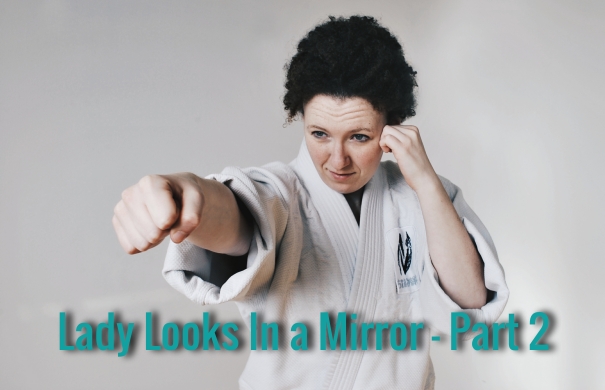
Lady Looks In a Mirror-Part 2

For those who may not know, “lady looks in a mirror” is an English translation of a Chinese martial arts term.

 It was common in Chinese martial arts to give techniques unique or “secret” names to differentiate those who were “insiders” of a martial arts system and those who were “outsiders.”

Chinese martial arts manuals would often have songs or chants, which were codified patterns. This practice in turn would aid in the memorization of forms.

I will use these classical Chinese terms as an introductory frame to explain my experience training with Hanshi Patrick McCarthy during his North American Tour.
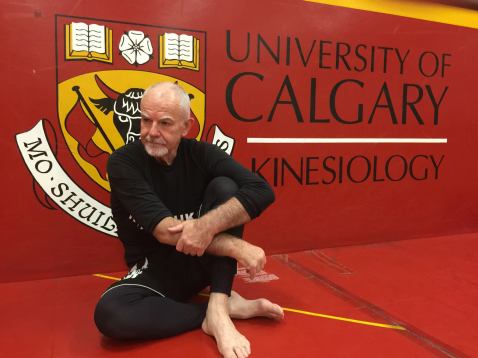
Hanshi Patrick McCarthy Calgary 2015

As said in my previous post, Lady Looks In a Mirror-Part 1, Riai Kumite translates into the harmonizing laws of grappling hands. Riai Kumite is a continuous flow of attacks and defenses between two people, which includes all the elements of fighting: groundwork, throws, percussive impact, etc.

This practice builds students practice from passive resistance to full on functional spontaneity, imitating real fighting in a safe and controlled format.

2015 Calgray Semina Tegume Line Drill

Although many pursue the martial arts for the ultimate goal of better health and self-defense, many practitioners lose sight of the intention behind techniques, destroying the gains that could be attained in practices like Riai Kumite.

Upon reflecting on the practice of this drill and how we engage with it with our partners, I see areas that sometimes inhibit Riai Kumite.

Intent

When I switch from one partner to the next, it is clear who understands intent—the intention of the technique, their intention towards me and the intention of the exercise—and who does not.

Technique

The first thing that gets lost for many people, especially beginner students, is the intention behind the technique. When I talk about this I am referring to the application formula: tool, location, direction, angle and intensity.

When people forget the intention of the technique (to emulate physical violence), they forget to:

  • Use the correct part of the body to attack
  • Aim!
  • Strike/Block from the correct direction
  • Strike/Block on the correct angle
  • Use the best amount of force for their situation

One simple example of this is punching in a straight line to the chin.
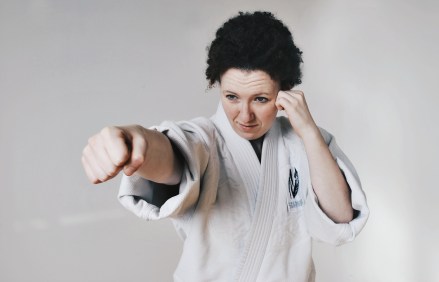
Inspiration Strikes

Now, you would think that the intent of this would be simple to understand. The intent is to punch in a straight line to the face.

Yet, in many instances, when hearing these instructions many people will throw bad hook punches and hammer fists while at the same time striking towards the chest, shoulder or even nothing at all!

Sometimes, this is a result of inexperience.

Or, it is the result of going too quickly, usually because people think it looks more impressive. At best, it hides poor execution.

When people fail to grasp the intention of a technique, the execution of the technique will be incorrect and the defence, as a consequence, will also be incorrect.

Thus, the learning process deteriorates and what would be Riai Kumite turns into nothing more than rough patty-cake.

And nobody likes rough patty-cake!

WINNING!

Usually someone’s attitude towards training in general will dictate how they treat you as a their partner.

There are those who feel the need to “win” when working with a partner—either through believing they’re superior in the amount of things they actually know or just through their physicality.
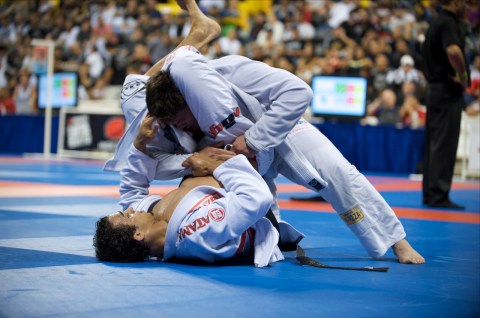
Winning

Alternatively, this inclination is the result of anxiety that our partner will harm us because of their size or rank. From this, we unknowingly up the tempo out of shear fear.

I should add that both these attitudes can be an unconscious act.

When people feel this way the response of many is to go harder and faster. The point of the exercise is not to go hard or fast, but to flow and realize where openings lie.
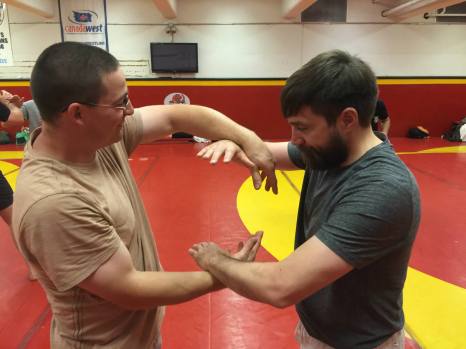
12027315_970272093033626_2380428736407085607_o

If we go too hard, the movements become rigid. If we go to fast, we can overlook blatant opportunities.

When there is a greater focus on how am I doing in comparison to another, whether we deem ourselves superior or inferior to our partner, there will always be an inclination to go harder and faster than is necessary—in the end, destroying one’s ability to learn effectively through Riai Kumite.

In other words, the goal of the exercise is not to “win.” That would imply that the exercise should have some type of definitive end. Rather, Riai Kumite can be infinite with the type of combinations of defences that can be accomplished.

The Exercise

Riai Kumite, as I have experienced it, demands a certain type of continuity or flow. As mentioned before, Riai is the concept of harmony. When this flow ends, you are no longer practicing Riai Kumite.

Many people may know many techniques, but perform them mechanically, restricting the transfer of energy between partners that should be performed in this exercise. When the movements become rigid, we lose the opportunity to perform techniques that demand continuity in order to be executed properly, for example any type of throw.

I’ve also watched people who know only three movements, but can gracefully flow between them.

10321639_970273003033535_1526866516991799222_o

I believe Riai Kumite as an exercise is dependent on being mindful of the correct intentions and not on how many techniques you know.

One must be mindful of

1) All the elements to execute the technique properly

2) The ego and how it affects the practice

3) The goal of the exercise

When we are mindful of these three things, one can achieve the harmony of grappling hands.

Ultimately, through changing partners and practicing Riai Kumite, I’ve learned that how we treat others and engage with the material we wish to practice is a reflection of our own ego and how honest we are with ourselves about our abilities.

My question for you is, what do you see when you look in the mirror?

That concludes what this lady reflects.
Lady Looks In a Mirror-Part 1

“A journey of a thousand miles begins with a single step.” –Lao Tzu

In the fall of 2015, I decided to follow the steps of my Sensei, Hanshi Patrick McCarthy, Head Instructor of Koryu Uchinadi and Director of the International Ryukyu Karate Research Society, on his North American Tour to Calgary, Toronto and Virginia.

Hanshi Patrick McCarthy Calgary 2015

As one pursues the Way, it is important to pause and, like a lady does in a mirror, reflect. In order to gain further understanding of the path of the martial arts, I reflect not on what we practice, but how we engage with it and with whom.

Lady Looks In a Mirror

Calgary, September 18th-21st, 2015

In Calgary, Sensei McCarthy introduced the concept of Riai Kumite.

Riai Kumite 理合組手

Ri理 are the universal laws of nature and their application.

Ai合 is the principle of harmony.

Kumite組手 is grappling hands or commonly translated as sparring.

When we combine these terms together they paradoxically mean the harmonizing laws of grappling hands. The purpose of this practice is to build a continuous flow of attacks and defenses between two people, which includes all the elements of fighting, including throws and groundwork.

2015 Calgary Seminar Sensei and Gary

With practice, students can move from passive resistance to full-on resistance. In the end, this methodology builds functional spontaneity in unscripted defensive scenarios.

Sensei McCarthy started the seminar by having the group practice two or three combinations out of the Koryu Uchinadi tegumi drills, which includes checking, trapping, blocking, joint-locking, twisting bones, cavity seizing and impacting pressure points.

The lesson started with the give and take of hook punches, hammer fists, and push-hands before new elements were added, like clinching, elbows, knees and much more.

By the end, our practice of Riai Kumite looked like full on street fighting, except safe and with control.

Koryu Uchinadi Calgary Seminar Wall Drill

Why Change Partners?

In Calgary, Sensei McCarthy had us constantly change partners through a line drill. With each new person you experience changing conditions, thus pushing you outside your comfort zone.

2015 Calgary Seminar Cody Grappling

Another benefit of changing partners is you learn to apply techniques against varying body types, which brings to light the principles that make such techniques effective.

The most common principles being:

  • The 5 ancient machines
    • Pulley
    • Wheel and Axel
    • Wedge/Inclined Plane
    • Screw (which is a variation on a wedge)
    • Lever
      • Class 1 (Load, Fulcrum, Effort)
      • Class 2 (Effort, Load, Fulcrum)
      • Class 3 (Load, Effort, Fulcrum)
  • 36 Habitual Acts of Physical Violence that, in Sensei McCarthy’s words, “represents the contextual premise, which Koryu Uchinadi is based on.”
  • Tool, Location, Intensity, Angle, Direction = The Application Formula

I have found that these concepts are overlooked in many martial arts. Often instructors haphazardly teach as they were taught without critically looking at the laws of physics that make them effective.

123.Class.Levers

By looking at martial arts as a set of principles, it allows you to transcend individual techniques and see the practice as a whole.

Yet, these are not the only things that become clearer.

The martial arts are more than the technical and mechanical elements that make it work. I feel that the understanding of these principles and how they work are dependent on understanding why we do them.

The combination of Riai Kumite and actively changing partners also brings to light the importance of intent and how it makes the difference between learning and just doing the drill for the sake of the drill.

Like looking into a hall of mirrors, the journey can seem infinite.

Stay tuned for the next step of the path with my look at the relationship between Riai Kumite, Partners and Intent.

KU Quick Tip Posture for Drive

5 Ways to Promote Your Martial Art on YouTube

Did you know that YouTube reaches more U.S. adults between 18 and 34 than any cable network?

YouTube allows you to reach a greater audience in an engaging way with low costs. This is just one reason why YouTube is the perfect social media platform to showcase your martial arts club.

Here are just a few types of videos to promote your club and style over YouTube:

1)   Instructional Videos

Instructional videos show the type of material the students will be learning. For potential students this format gives insight into the instructor’s teaching style.

At the same time, these tutorial style videos act as review and give deeper insight into techniques for current students.

2)   Kata Applications

The average novice will look at a kata application video and see it as no more than a demonstration. However experienced martial artists, especially in the East Asian traditions, will have a great appreciation for functional applications.

A video containing what has become known as Bunkai in Karate is a great way to generate conversation about your style and build relationships in the online martial arts community.

3)   Testimonials

Testimonials act as social proof and are a key factor in building consumer trust. Video testimonials are also an effective way to attract a specific demographic, like children, women and seniors. When potential students see others like themselves, they are more likely to check out your school.

4)   Demonstrations

Demonstration videos are an awesome way to add entertainment value. These types of videos should showcase the best your martial arts school has to offer. This not only shows future students what they will one day learn, it also gives them something to aspire to.

5)   Competitions

If you are in a competitive martial art, like Brazilian Jujitsu or Tae Kwon Do, posting competition videos are another great way to build consumer trust. It will also attract potential martial arts students with a competitive edge.

Keep in mind, each video format will attract a different audience and potentially a different student base.

Be sure to know your goals and post quality content that will attract the ideal audience to your martial arts community both on and offline.

Thanks for reading!

Stay tuned for more ideas on how to promote your martial art on social media.


The Muse

For those who don’t know their Greek Mythology, the nine muses are the personification of knowledge and the arts and are the daughters of Zeus and Mnemosyne. The muses inspire creativity with their grace and skills in writing, song, dance and theatre.

9 Muses

A muse is a force personified as a woman, who is the source of inspiration for creative artist, or in this case a martial artist. The purpose of this endeavour is for me to share my own insight, creativity, and passion with other martial artists to bring out the best in our practices.

Ideas

With that said, I make no claim of expertise above and beyond my fourteen years in the martial arts.  There are far more knowledgable experts out there in the martial arts. I am still in my infancy.

Rather, my intention is to:

  1. Help others navigate through the sometimes frustrating, but always rewarding learning process
  2.  Inspire ideas for teaching classes and seminars
  3. Promote the martial arts, its teachings and philosophy