It’s better to have a tool and not need it than need a tool and not have it.
This point summarizes the necessity of adding grappling to our fighting repertoire. And as I mentioned in the first part of this series based on my learning experience with Sensei Paul Lopresti, grappling is a common aspect of self-defence overlooked by many karate practitioners. I find this especially frustrating because so many kata techniques are applicable on the ground, as illustrated in my previous discussion of kokutsu dachi and knee on belly position.

Another standing technique found in karate and other striking arts is the hiza geri (knee). If someone is properly executing a hiza geri with all their body weight moving into the technique and the hips driving forward, one can very much see the mechanical similarity of the hips in shiko-walk.
The shiko-walk is a common grappling technique used in a double leg take down or the knee cutter guard pass to kesa-gatami, in which you press your knee onto the inside of the opponent’s thigh.
With that said, Sensei Paul spun further applications of hiza-geri through his presentation of a ground drill of his own creation, completely committed to the bottom position, called Ura Ne-Waza. Based on my understanding, the creation of the drill was a critique of common grappling practices. Most BJJ clubs teach grappling from a superior top position and rarely address ways of being successful while on one’s back.
The inspiration for ura ne-waza was one of Sensei Paul’s female students. She constantly found herself on her back against bigger opponents—the type of opponent a woman is most likely to find herself against. With ura ne-waza, students can protect themselves against larger opponents by using various restraining techniques and submissions, like the guillotine or kimura, from their back.

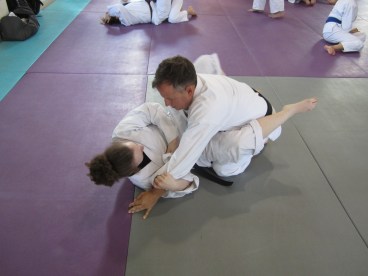
One position in the drill is called “knee in guard,” which uses the exact same body mechanics of a standing knee strike or shiko-walk.
In this position you stick to the opponent’s body by:
- Under-hooking the left arm with your right arm and grabbing the opponents right wrist with your left hand
- Pressing your left knee into the crevice of the elbow and bracing the bottom of the left foot on the right side of the opponent’s hip.

In doing the “knee in guard” position, you prevent the opponent from attempting a series of punches towards the head. It also acts as a potential transition into a multitude of submissions, such as omo-plata or the kimura.
Through these controlling positions, I learned that as the opponent struggles like prey within a web, you have a better sense of where they will turn next and can capitalize on their position.
Also, the hip rotation used to generate power in all striking techniques, strongly emphasized in Koryu Uchinadi Kenpo Jutsu, is another way to create space to escape holds and to transition into other submissions on the ground.
For example, in transitioning to the guard when the opponent is in a mount, explosive hip movement is paramount to accomplishing an escape. This movement is comparable to expanding into any standing striking technique. The feet plant on the floor as the arms push the opponent’s knee out, and one side of the hip drives forward while the other side retracts back, just like a gyaku-tsuki.
Furthermore, the strength of hip and core rotation is a necessity for all transitional movements. The ability to interweave a series of movements, such as how you move into your arm bar or your kimura from the guard, determines your success. Whenever there is movement, there is potential for space, and with space comes the potential for the opponent to escape or counter your efforts.
As I learned while going through Sensei Paul’s arm bar and kimura series, knowing how to create and limit space is fundamental. In the arm bar and kimura sets, Sensei Paul taught several different ways of getting into these techniques. The web of fighting starts when we are given several different options from a single position. In doing so, we learned to recognize specific situations that could allow us to transition from the guard to our desired submission. As we moved from the guard to our submission, we integrated a hip swivel to adjust angles and isolate the joint we were attacking, necessitating that we rotate our hips just like in our usual standing practice.
Throughout the seminar, Sensei Paul not only demonstrated his understanding of the body mechanics of ground techniques, but also demonstrated his ability as a teacher and coach. Sensei Paul taught individuals of varying backgrounds, such as BJJ, wrestling and karate. He explained techniques in a way that could be understood by individuals of any martial arts background. He is both patient and intellectual in his approach to teaching a group or an individual.
I feel we benefitted the most from Sensei Paul’s instruction in two ways. The first was through rolling. At the end of the seminar, we were given the opportunity to experiment with the variety of techniques we learned via two-minute grappling sessions. While rolling, we were told to go at different intensity levels, for example 60 percent, so everyone could practice in a safe and fun manner.

The other opportunity we were given to gain knowledge was to ask questions. In Sensei Paul’s seminars, he gives everyone the opportunity to ask him about their experiences, what worked for them or didn’t work for them in the past as well as in the rolling session. In this way, Sensei Paul can tweak the techniques to fit the individual style, strengths and size of the student.
Although most karate practitioners do not pursue ground techniques, their standing technical knowledge operates on the same body mechanics as ground techniques.
You can observe the connective thread between standing and ground techniques through:
- Kokutsu dachi and knee on belly position
- Knee strike in comparison to both shiko-walk and “knee in guard” position
- Hip rotation while doing a hip escape from the mount or transitioning to an arm bar from the guard
The body, of course, can only move in so many ways. We should expect that how we generate power standing can be applied the same way on the ground. Yet many karate practitioners continue to turn a blind eye to the importance of ground work and grappling, even when common sense dictates that the principles of physics and body mechanics are applicable no matter what position someone is in.
The concepts found in our standing repertoire cannot be completely understood unless we recall karate’s true purpose: self-defence. To claim the art as self-defence and not address all the Habitual Acts of Physical Violence causes many to get stuck in one corner of their web. True martial artists must explore the concepts found in their systems with a critical gaze to see how the threads of their own practices connect with all other styles.
Looking for more striking inspiration? Follow The Martial Arts Muse on Facebook or Subscribe!





 The Martial Arts Muse